
Ante-Post Greyhound Betting: Complete Guide to Early Prices, Strategy & Major UK Races
 Available in US
Every ante-post greyhound bet is a bet against time. The odds are bigger, the risks are real, and understanding both is what separates informed punters from hopeful ones.
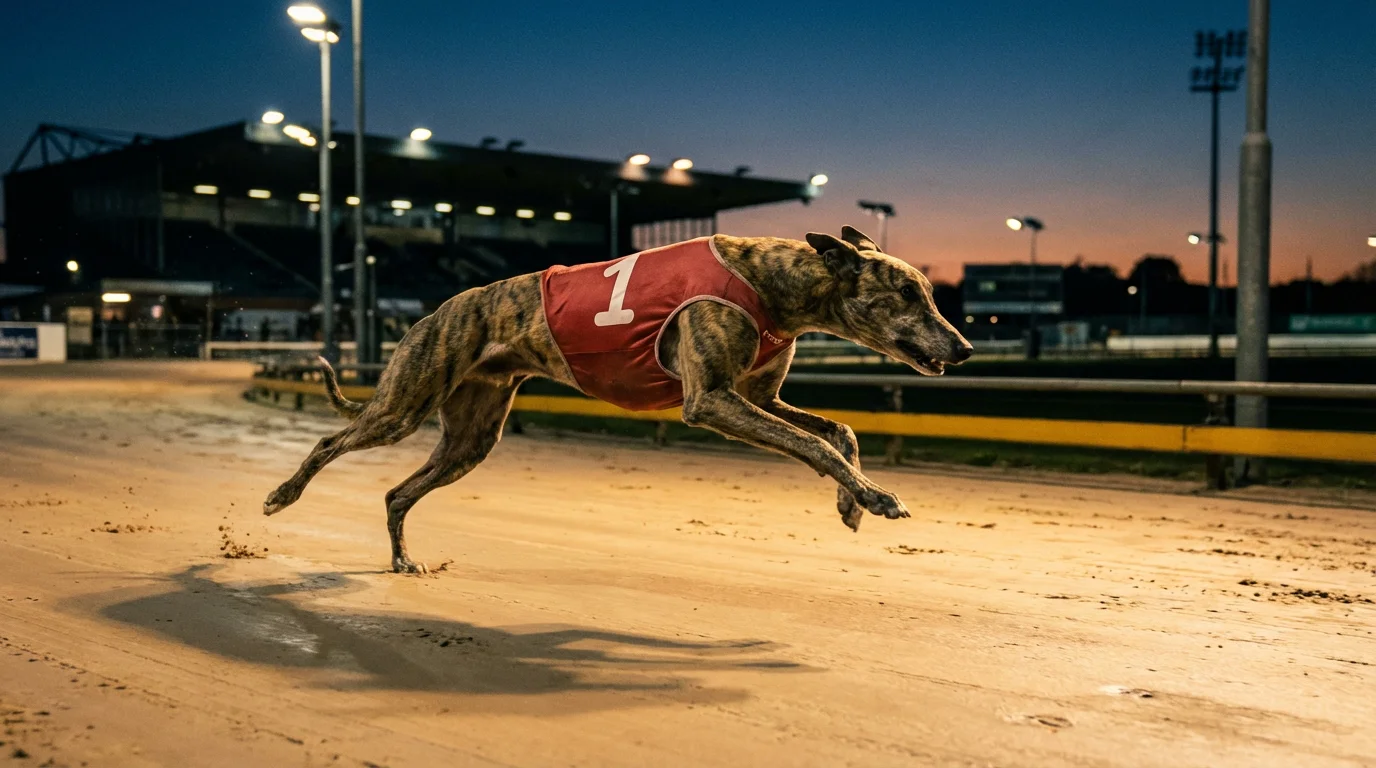
Every ante-post greyhound bet is a bet against time. You are placing money on an outcome that won't be settled for weeks — sometimes months — and in that gap between bet and resolution, almost anything can happen. A dog pulls a muscle in a trial. A kennel gets a virus. A champion that looked untouchable in February gets drawn against two fast breakers in a quarter-final heat and never makes the final. Your stake, in most cases, is already gone.
That tension — between the lure of inflated odds and the very real possibility of losing your money before the race even starts — is what makes ante-post greyhound betting one of the most distinctive corners of UK sports wagering. It is not day-of-race betting with better prices. It is a fundamentally different discipline, one that rewards research, patience, and a tolerance for losing bets that were perfectly rational at the time they were placed.
The principle is straightforward. Ante-post means betting before the final declarations — before the field is confirmed, before trap draws are made, and often before the tournament's first heat has been run. In greyhound racing, where major events like the English Greyhound Derby operate as multi-round knockout competitions, this window can stretch six weeks or more. The bookmaker offers early prices on the outright winner. You either take the price or you don't. If your selection doesn't make the final — for any reason — the default position across most bookmakers is that your stake is forfeited. No refund, no Rule 4 deduction, no second chance.
And yet punters keep coming back to these markets. The reason is simple: the odds are significantly better. A dog that might be 5/1 on final night could have been available at 33/1 six weeks earlier. The bookmaker is compensating you for carrying the uncertainty — the risk that your selection might not survive the heats, might pick up an injury, might simply not travel well to the host track. That premium is the entire point of ante-post betting, and understanding how to evaluate it is what separates informed punters from hopeful ones.
What is ante-post greyhound betting?
Ante-post (from the Latin ante, before, and post, the starting post) refers to bets placed on a greyhound event before the day of the race — typically weeks in advance of a major tournament final. Unlike day-of-race wagers, ante-post bets are placed at fixed odds agreed at the time of the bet. The critical difference: if your greyhound is withdrawn, injured, or fails to qualify for the final, your stake is usually lost. In return, ante-post odds are considerably longer than those available on race night.
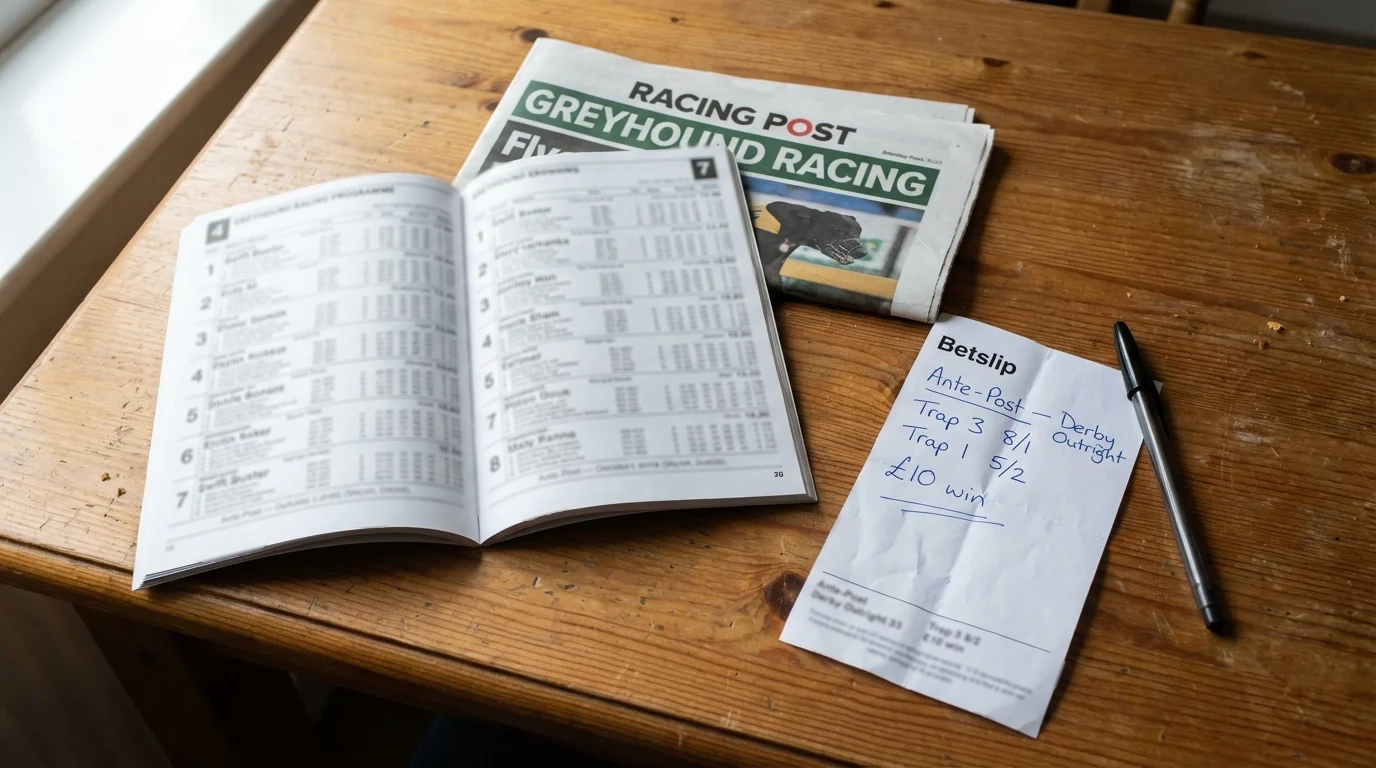
This guide covers the full landscape of ante-post greyhound betting in the UK. From how the mechanics work and what happens when your selection doesn't run, through the major races that carry futures markets, to the strategic frameworks and risk realities that every serious bettor should understand before committing a penny to an outright wager. Whether you've been betting ante-post for years or you're trying to figure out whether it's worth the risk, this is the reference you'll want to have open.
How Ante-Post Greyhound Betting Works
The mechanism is simple; the consequences are not. Ante-post greyhound betting follows a lifecycle that most punters grasp intuitively but few think through completely before placing a bet. Understanding each stage — from market opening to settlement — is the difference between making an informed wager and buying a lottery ticket with worse odds of a refund.
The process starts when a bookmaker opens an outright market on a major greyhound event, typically four to six weeks before the first heats. At this stage, the field is speculative. The bookmaker's trader prices up a list of likely entries based on grading form, kennel reputation, trial times, and historical patterns. These early prices reflect maximum uncertainty: the trader doesn't know which dogs will actually be entered, which will be fit, or how the draw will play out across multiple rounds. That uncertainty is baked directly into the odds.
Once you place your bet, the price is locked. This is a fixed-odds wager — you get the price you took, regardless of how the market moves afterwards. If your dog shortens from 25/1 to 8/1 as the tournament progresses, you still hold the original price. That's the upside. The downside is equally rigid: if your dog is withdrawn, injured, or eliminated in an early round, your bet is settled as a loser. The stake doesn't come back.
The word "ante-post" traces back to the physical betting post at racecourses — the marker near the start where bookmakers would take bets. In modern usage, particularly in greyhound racing, the term means bets placed well before the event — days or weeks in advance, not minutes.
What Qualifies as an Ante-Post Greyhound Bet?
The definition varies between bookmakers, and this is worth understanding before you place a bet. Some bookmakers classify any wager placed before the day of the race as ante-post. Others draw the line at a specific cut-off — for instance, bets placed before final declarations or before the last round of heats. The practical implication is significant: if a bookmaker defines ante-post as ending when the six finalists are confirmed, then a bet placed on the morning of the final might not carry ante-post terms. It might instead be treated as a standard race-day bet, potentially with different non-runner rules and even different odds.
For major tournaments, the ante-post window usually begins when the bookmaker opens the outright market — often when the entry list is first published or when trials start generating meaningful form data. The window closes at a point defined in the bookmaker's terms, which you should check before wagering. The safest assumption: if the bet is described as "ante-post" on your betslip, you are accepting ante-post terms, including the non-runner risk.
Ante-Post vs Starting Price: The Timing Split
Starting Price (SP) betting and ante-post betting occupy opposite ends of the risk spectrum. With SP, you accept whatever odds are available at the moment the race begins. The field is confirmed, the traps are drawn, every variable except the race itself is resolved. Your downside is limited to losing the bet if the dog doesn't win — you won't lose your stake to a non-runner.
Ante-post flips this equation. You lock in a price weeks before the event, and that price includes a premium for every unresolved variable. The dog might not make the final. The trainer might withdraw the dog for tactical reasons. Injury, illness, or a poor draw could end the campaign before the semis. You're paying for the privilege of an early price by accepting the full weight of that uncertainty. When the price is right and the selection survives, the reward is substantial. When it doesn't survive, the loss is total.
Ante-post bet lifecycle: English Greyhound Derby
April — Market opens. You back Dog X at 33/1 with a £10 stake.
Late April — First-round heats begin. Dog X wins its heat. Odds shorten to 20/1. Your bet remains at 33/1.
May — Quarter-finals. Dog X drawn awkwardly in trap 6, finishes third. Eliminated.
Result: Bet settles as a loser. Stake of £10 is forfeited — no refund, no deduction.
If Dog X had reached and won the final: Payout = £10 x 33 + £10 stake = £340.
The worked example above illustrates the brutal clarity of the ante-post proposition. There are no partial refunds for "nearly making it." A dog eliminated in the quarter-finals and a dog that never entered the competition in the first place produce the same outcome for your betslip: zero return. That's the deal. The only question is whether the price adequately compensates you for accepting it.
Non-Runner Rules in Ante-Post Greyhound Betting
Your dog pulls up lame in the semis — your money is already gone. This is the sentence that every ante-post greyhound bettor needs to absorb before placing a single wager. The non-runner rule is the defining feature of ante-post betting, and it is the one that catches inexperienced punters hardest.
The default position across virtually all UK bookmakers is absolute: if your selected greyhound does not run in the final of the event you bet on, your stake is lost. It doesn't matter why. Injury, illness, disqualification, tactical withdrawal by the trainer, failure to qualify through the heats — the result is the same. The bet is settled as a loser, and no portion of your stake is returned.
Warning: Ante-post stakes are not refunded if your selection is withdrawn or fails to qualify. This is the standard rule, not the exception. Always check your bookmaker's specific ante-post terms before placing a bet.
This is not a quirk or a technicality. It is the structural foundation of ante-post pricing. The reason bookmakers offer 25/1 on a dog that might be 4/1 on final night is precisely because they know a significant percentage of selections will never reach the final. The longer odds reflect the genuine probability that you will lose your stake to a non-runner, not just to a losing race result. If bookmakers refunded non-runner stakes by default, ante-post prices would collapse to something resembling race-day odds — and the market would lose its entire purpose.
The scenarios that trigger a non-runner loss in greyhound ante-post are more varied than in horse racing. In a flat horse race, a non-runner means the horse was withdrawn before the race. In greyhound tournament betting, the non-runner net is much wider. A dog that enters the Derby, wins its first-round heat, but then gets injured before the quarter-finals is a non-runner for the purposes of your outright bet. A dog that is eliminated in the semi-finals — beaten fair and square, no injury — is also a losing bet. In both cases your ante-post wager returns nothing.
Then there's Rule 4, which applies to late withdrawals on race day in standard greyhound racing. In ante-post markets, Rule 4 generally does not apply. If you've bet ante-post on a Derby outright winner and one of the six finalists is withdrawn on the day of the final, your bet won't benefit from a Rule 4 deduction to compensate for the reduced field. The exceptions are rare and bookmaker-specific — always check the small print, but don't count on Rule 4 protection for ante-post wagers.
Retirement and disqualification present edge cases. If a greyhound is retired from racing between the time you place your ante-post bet and the event final, the bet is void with some bookmakers and a loser with others. The same variability applies to GBGB disqualifications. These distinctions are not academic — they are the difference between losing your stake and getting it back.
No Runner No Bet Offers for Greyhound Futures
The one significant exception to the non-runner forfeiture rule is the "No Runner No Bet" (NRNB) promotion. Several UK bookmakers periodically offer NRNB terms on major greyhound ante-post markets, meaning that if your selected dog doesn't run in the final, your stake is refunded rather than forfeited.
NRNB offers are not standard. They are promotional — bookmakers use them to attract ante-post volume on marquee events like the English Greyhound Derby or the Irish Derby. The terms typically apply to specific races during specific windows, and the conditions can be narrow. Some NRNB offers only cover outright non-entry (the dog never competes in the tournament at all) rather than elimination during heats. Others protect you through the entire tournament but cap the maximum stake that qualifies. Star Sports, BoyleSports, and William Hill have historically offered NRNB promotions on greyhound futures, though availability and terms change from year to year.
If NRNB is available, it fundamentally changes the risk calculus of an ante-post bet. The main downside — losing your stake to a non-runner — is eliminated, but the odds will typically be slightly shorter than non-NRNB equivalents. That trade-off is almost always worth taking for recreational bettors who want ante-post exposure without the full sting of the forfeiture rule.
Why Ante-Post Odds Are Bigger on Greyhounds
Bookmakers price uncertainty — and greyhound racing has it in bulk. The reason ante-post odds dwarf race-day prices is not generosity. It is arithmetic. The bookmaker is asking you to accept a basket of risks that evaporate as the event progresses, and the price you receive is calibrated to that risk load.
Consider the variables at play when an ante-post greyhound market opens six weeks before a major final. The entry list is provisional. Dogs haven't been drawn into heats yet. Injuries could happen at any point across five or six rounds of competition. Trap draws — which dramatically influence outcomes in greyhound racing — are unknown. Form fluctuations in greyhounds are sharper and less predictable than in thoroughbred horse racing; a dog running 28.6 in February might be running 29.1 by May. And unlike horse racing, where a field of 20 runners is considered large, a major greyhound tournament can start with 192 entries funnelled down to six finalists. The attrition rate is staggering.
Each layer of uncertainty widens the odds. A bookmaker pricing an outright Derby market six weeks out isn't just estimating which dog will win the final. They're estimating which dogs will survive five elimination rounds, which trainers will keep their entries fit, how the draws will shape each round, and which dogs will handle the specific track. That's an enormous amount of unknown territory, and the price reflects it.
| Ante-Post Odds (6 Weeks Out) | Final Night Odds (Same Dog) |
|---|---|
| 33/1 | 5/1 |
| 20/1 | 7/2 |
| 50/1 | 10/1 |
| 8/1 (favourite) | 6/4 (favourite) |
Illustrative comparison: typical ante-post vs final-night prices for the same greyhound in a Derby scenario. Actual odds vary by event and bookmaker.
Greyhound ante-post markets are also thinner than their horse racing equivalents. In horse racing futures — say, an Epsom Derby ante-post market — the bookmaker can reference extensive breeding data, racecourse records, time-form databases, and a broad public betting market that quickly corrects mispricing. Greyhound futures lack most of this infrastructure. The form database is shallower, public betting volumes are lower, and the information asymmetry between insiders (trainers, kennel staff) and the betting public is wider. Thin markets produce wider spreads, and wider spreads mean bigger prices.
There's a secondary factor: the tournament knockout format compresses value into the ante-post window. In horse racing, a Gold Cup ante-post favourite might shorten from 6/1 to 3/1 between market opening and race day. In greyhound racing, the same dog might move from 25/1 to 3/1 as it progresses through five rounds. The price compression is extreme, and the value capture for early backers is correspondingly large — if the dog makes the final.
Major UK Greyhound Races with Ante-Post Markets
The Derby swallows more ante-post money than every other race combined. But it is not the only event on the UK and Irish greyhound calendar that carries a meaningful futures market. A handful of Category One competitions offer ante-post betting opportunities throughout the year, each with its own character, distance, venue, and market dynamics. Knowing this calendar is not optional — it is the structural backbone of any ante-post greyhound betting approach.
The 2026 season holds particular significance. Greyhound racing in Great Britain celebrates its centenary this year, with the GBGB confirming a bumper schedule of 50 Category One competitions and 27 Category Two events across the calendar. That expanded programme means more races carrying ante-post markets and more opportunities for bettors who understand the terrain.
English Greyhound Derby
Towcester, 500m. Knockout format, up to 192 entries. Winner's prize: £175,000 in 2026. Heats begin late April, final in early June. The single biggest ante-post greyhound market by volume.
Irish Greyhound Derby
Shelbourne Park, Dublin, 550 yards. Sand track, strong cross-border entries. Traditionally held in September/October. The second most prestigious greyhound race globally.
Greyhound St Leger
A staying classic run over 700m+. Stamina test — a completely different form profile to the Derby. Historically held at Wembley and Perry Barr, it moved to Nottingham in 2025. Favours strong, late-running dogs. Ante-post dynamics reward patience.
Scottish Greyhound Derby
Shawfield, Glasgow. Smaller field, less market depth. Regional but fiercely contested, occasionally offering outsized ante-post value.
Pall Mall Stakes
Oxford, 450m. A sprint-oriented Classic with a long history. One of several Oxford Category One events in 2026.
Cesarewitch
A stayer race with historic pedigree. Tests endurance over longer distances, attracting a different profile of ante-post contender.
Select Stakes
Invitational format — only the best-performing dogs are invited. Restricted field means tighter ante-post pricing but higher-quality runners.
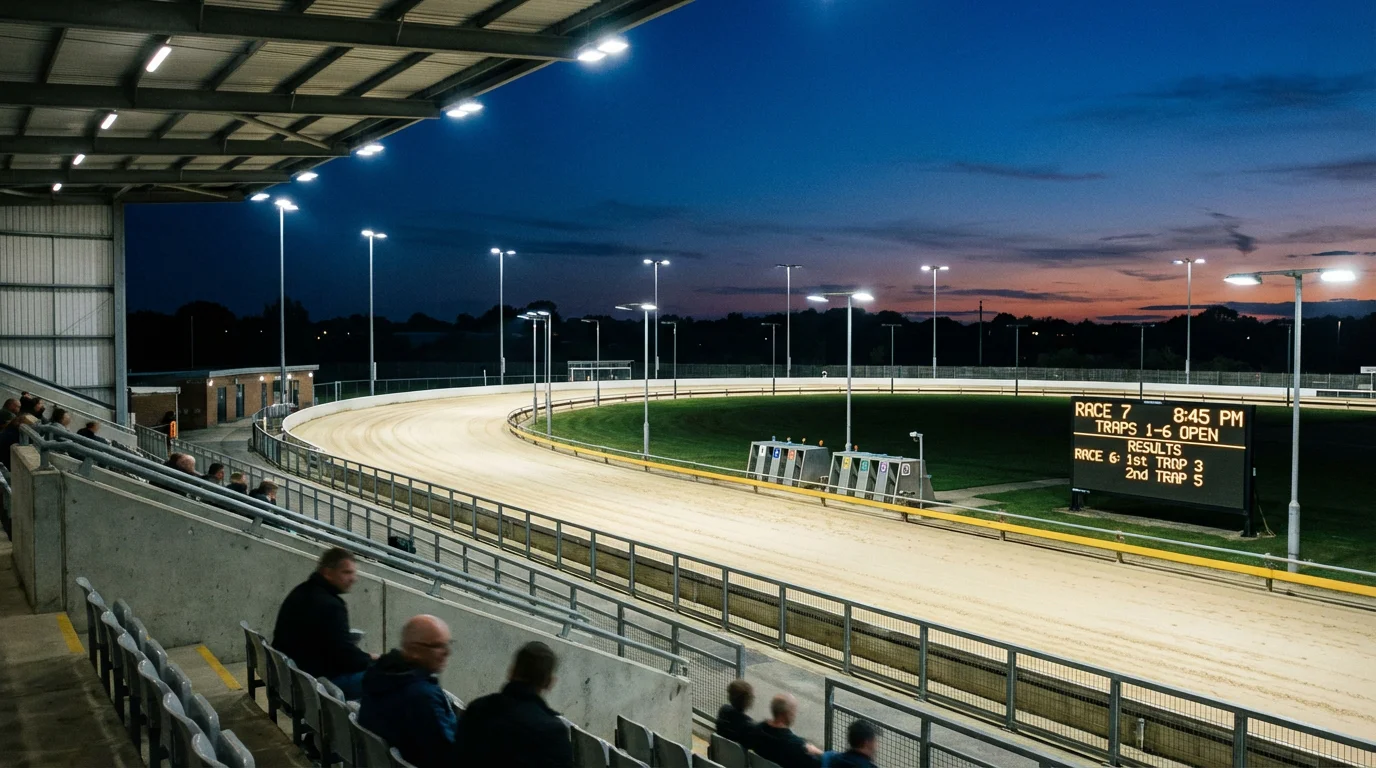
English Greyhound Derby Ante-Post Markets
The English Greyhound Derby is the gravitational centre of UK ante-post greyhound betting. The 2026 edition at Towcester — the Star Sports and Orchestrate English Greyhound Derby — runs from April 30 through to the final on June 6, with first-round heats spread across three days and the knockout format compressing 192 entries down to six finalists over roughly five weeks. Ante-post markets typically open four to six weeks before the first heats, meaning punters can start placing wagers as early as March.
Last year's running demonstrated the volatility that makes this market so compelling. Droopys Plunge, a 10/1 shot on final night who had been available at considerably longer prices during the ante-post phase, upset the heavily fancied Bockos Diamond and defending champion De Lahdedah. It was a reminder that the Derby ante-post market is not a coronation — it is a six-week war of attrition where trap draws, injuries, and on-the-night pace can upend even the most confident ante-post positions.
Irish Greyhound Derby and Cross-Border Entries
The Irish Greyhound Derby at Shelbourne Park is the second pillar of the ante-post greyhound calendar. Run over 550 yards on sand, it attracts Ireland's strongest kennels — most notably Graham Holland's Riverside operation, which has dominated both the English and Irish Derbies in recent years. Cross-border entries are a defining feature: dogs that compete in the English Derby frequently reappear in the Irish Derby, and ante-post punters who track both tournaments can exploit form overlaps and price discrepancies between the two markets.
The Irish Derby typically takes place in the autumn, giving ante-post bettors a window to assess summer form and trial performance before committing. Shelbourne's 550-yard distance adds a stamina variable that the 500m English Derby doesn't fully test, meaning different form profiles emerge as value ante-post picks.
St Leger, Pall Mall and Other Category One Races
The Greyhound St Leger, historically held at Wembley and more recently at Perry Barr over 710m (Nottingham over 730m from 2025), is the truest stamina test on the UK greyhound calendar. Ante-post markets for the St Leger attract a different kind of bettor — one looking for strong-finishing, durable dogs rather than the explosive early-pace specialists that dominate the Derby. The form analysis required is different, the trainer profiles that succeed are different, and the prices tend to be wider because the public betting market is thinner.
The Pall Mall Stakes at Oxford occupies a different slot: a sprint classic over 450m where early pace and trap draw carry enormous weight. Oxford's increased schedule for 2026 — eight Category One events, a record for the track — makes it a venue to watch for ante-post opportunities beyond the Pall Mall itself.
The Cesarewitch and the Select Stakes round out the top tier of the ante-post calendar. The Cesarewitch tests endurance over distance, producing ante-post dynamics that reward punters who study staying form rather than raw speed. The Select Stakes, an invitational event, limits the field to elite dogs, creating a tighter ante-post market with shorter prices but higher certainty about the quality of runners.
Ante-Post Greyhound Betting Strategy
Strategy in ante-post greyhound betting isn't about picking winners — it's about pricing risk. The distinction matters. Day-of-race betting rewards you for identifying the fastest dog in a confirmed field over a known distance from a drawn trap. Ante-post betting rewards you for correctly evaluating how much uncertainty the market is pricing in and whether the odds compensate you for carrying that uncertainty over weeks of competition.
This is why most ante-post greyhound strategies fail. They import day-of-race thinking into a fundamentally different problem. A punter who backs the "best dog" at 8/1 ante-post is not making a strategic bet — they're making a prediction about the future and paying for it. A strategic ante-post bettor asks a different question: given this dog's probability of reaching and winning the final, is 8/1 generous enough to justify the risk of total stake loss? If the answer is no, the bet doesn't get placed, regardless of how talented the dog is.

When to Place Your Ante-Post Greyhound Bet
Timing is the first strategic lever, and it operates on a clear trade-off curve. The earlier you bet, the longer the odds — and the higher the risk. The later you bet, the more information you have — and the shorter the price.
Three timing windows define the ante-post greyhound calendar. The ultra-early window, six or more weeks before the first heats, offers maximum odds and maximum uncertainty. You might be backing a dog based on trial times and kennel reputation alone, with no confirmed entry list or draw.
The pre-heat window, one to two weeks before the tournament begins, offers a balance. Entry lists are published, trials have been observed, and the form picture is clearer. Odds have shortened but remain significantly longer than race-day equivalents. This is where many experienced ante-post punters prefer to operate.
The mid-tournament window provides maximum clarity. You can watch dogs run and assess how they handle the specific track. But prices compress sharply with each surviving round — a dog at 25/1 before the heats might be 6/1 after winning a quarter-final.
Form Factors That Matter for Greyhound Futures
Form analysis for ante-post greyhound betting is forensic work, not casual observation. The variables that matter most are those that predict performance across multiple rounds at a specific track over several weeks — not just who ran fastest last Saturday.
Sectional times are the backbone. A greyhound's time to the first bend (the sectional) reveals early pace, which is critical in trap-based racing where the run to the first turn often decides the race. For ante-post purposes, look at consistent sectional times across different tracks and conditions rather than one outstanding run. Consistency signals reliability — a trait that matters immensely over five rounds of knockout competition.
Grade consistency tells you whether a dog has been tested against quality opposition. A dog winning A1 races comfortably is a more credible ante-post selection than one racking up victories in A4 or A5 company. Distance suitability is equally important: the English Derby runs over 500m, the Irish Derby over 550 yards, the St Leger over 710m. Picking a dog whose form is built over the wrong distance is a common ante-post error.
Trap versatility — the ability to perform from any trap position — is perhaps the most underrated form factor in ante-post greyhound betting. In a knockout tournament, dogs are drawn into different traps each round. A specialist that only performs from trap one or trap six is at a structural disadvantage across five rounds of randomised draws. Dogs that can win from any box have a survivorship edge that compounds through each elimination round.
Age matters too. Greyhounds typically peak around age two to three. A dog approaching its fourth birthday may still have the raw speed, but recovery between rounds, resilience under tournament pressure, and the cumulative physical toll of a multi-week competition all favour younger animals.
Trainer and Kennel Analysis for Ante-Post Picks
The best ante-post greyhound bet often isn't a dog — it's a trainer. Major tournament success in greyhound racing clusters around a small number of elite kennels, and the data is emphatic. Graham Holland has dominated recent English Greyhound Derbies, winning in 2022 and 2023 and placing multiple finalists in subsequent years. Charlie Lister OBE holds the all-time record with seven Derby victories. Patrick Janssens, who trained 2025 winner Droopys Plunge and 2021 champion Thorn Falcon, has proven his ability to prepare dogs specifically for the Towcester track.
Kennel strength — the number and quality of entries a trainer runs in a major tournament — is a proxy for probability. A trainer entering eight dogs in the Derby has more chances of getting one through to the final than a trainer entering two. This is not a subtle point: when Graham Holland sent three dogs to the Derby final in 2025, his kennel was effectively covering multiple outcomes. Ante-post bettors who follow kennel strength rather than individual-dog hype tend to survive longer in these markets.
Liam Dowling, whose De Lahdedah won the 2024 Derby and set the Towcester track record of 28.58 seconds, is another name that recurs in ante-post calculations. Dowling's ability to produce peak-condition dogs for major finals has made his kennel a consistent factor in both English and Irish Derby futures. When assessing an ante-post market, the question is not just "which dog will win?" but "which trainer has the process to get dogs to the final in winning shape?"
Before placing an ante-post greyhound bet
- Check the bookmaker's non-runner terms — confirm whether NRNB applies or your stake is forfeited on withdrawal
- Verify the dog's form at the specific distance of the event (500m for the Derby, 710m for the St Leger, etc.)
- Review the trainer's record in major tournaments — finalist counts, not just winners
- Assess trap-draw flexibility: can the dog perform from any box, or is it a specialist?
- Confirm market liquidity — is the price available at meaningful stakes, or is it a thin market where the odds may not hold?
- Set a loss limit: define the maximum you're prepared to commit to ante-post bets for this event before placing any wagers
How to Compare Ante-Post Greyhound Odds
Price differences of 10/1 between bookmakers are normal in these markets. That sentence is not hyperbole — it is the practical reality of ante-post greyhound odds comparison. A dog might be 25/1 with one bookmaker and 14/1 with another on the same afternoon, for the same event, on the same outright market. In horse racing ante-post, you'd see some variation, but a spread of that magnitude would be unusual. In greyhound futures, it is Tuesday.
The reason is structural. Greyhound ante-post markets are thin. They attract lower betting volumes than horse racing equivalents, which means bookmaker traders have less market signal to work with and less pressure to align their prices with competitors. Each trader prices the market semi-independently, based on their own assessment of form, kennel strength, and anticipated liability. The result is significant price divergence — and that divergence is where a substantial portion of ante-post value lives.
Ante-post greyhound odds can vary by a factor of three or more between bookmakers for the same dog in the same event. A selection available at 40/1 with one firm might be 12/1 with another — a spread far wider than you'd see in horse racing, football, or almost any other UK betting market.
The practical implication is that odds shopping is not a nice-to-have in ante-post greyhound betting — it is where a large share of the edge comes from. Taking 16/1 on a dog when 25/1 is available elsewhere is not just a missed opportunity; it is a material reduction in your expected value over time.
Oddschecker remains the primary comparison tool for UK ante-post greyhound odds, aggregating prices from major bookmakers on outright markets when they're available. The limitation is that not all bookmakers list their greyhound ante-post markets on Oddschecker, and some prices update with a delay. For the most accurate comparison, checking individual bookmaker sites directly — particularly Star Sports, BoyleSports, Bet365, William Hill, and Coral — alongside the aggregator gives a more complete picture.
When comparing prices, don't stop at the headline odds. Factor in each bookmaker's non-runner terms. A dog at 25/1 with standard ante-post terms (stake lost on non-runner) and the same dog at 20/1 with NRNB terms represent different value propositions despite the shorter price carrying the NRNB protection. The effective value of the NRNB offer depends on your estimate of the dog's probability of reaching the final — if you think there's a 40% chance the dog won't make it, the NRNB version at 20/1 may actually deliver better expected value than the 25/1 without protection.
Each-way terms add another comparison layer. Place terms (the fraction of the odds paid on the place portion) and the number of places offered vary between bookmakers on ante-post events. A bookmaker offering 1/4 odds for two places is a different proposition from one offering 1/5 odds for three places. This matters most in events with larger fields where the each-way component carries more weight.

The overround — the bookmaker's built-in margin across all selections — is typically higher in greyhound ante-post than in horse racing equivalents. In a typical greyhound Derby ante-post market, expect an overround of 130-150%, compared to 110-120% for horse racing futures. That extra margin is the cost of operating in a less liquid market, and it makes odds shopping even more important.
Each-Way Ante-Post Greyhound Betting
Each-way on ante-post looks generous — until you read the small print. Each-way (E/W) ante-post greyhound betting splits your stake into two parts: one on your selection to win the event outright, and one on your selection to place (typically to finish in a specified number of positions). It doubles your total outlay but provides a partial safety net if your dog reaches the final without winning it.
The mechanics are standard. If you place a £10 each-way bet at 20/1, you're actually placing two £10 bets: £10 on the win at 20/1, and £10 on the place at a fraction of the odds (typically 1/4 for greyhound events). Your total stake is £20. If the dog wins, you collect on both the win and place portions. If the dog finishes in a qualifying place but doesn't win, you collect only the place portion. If the dog doesn't place — or doesn't reach the final at all — you lose both stakes.
Each-way ante-post bet: English Greyhound Derby
| Selection | Dog Y — Outright Winner |
| Odds | 20/1 |
| Each-way terms | 1/4 odds, 2 places |
| Stake | £10 each way (£20 total) |
If Dog Y wins: Win part = £10 × 20 = £200 + £10 stake. Place part = £10 × 5 (20/1 at 1/4 = 5/1) = £50 + £10 stake. Total return = £270.
If Dog Y finishes 2nd: Win part lost = −£10. Place part = £10 × 5 = £50 + £10 stake = £60. Net result = +£40.
If Dog Y doesn't reach the final: Both stakes lost = −£20. No refund under standard ante-post terms.
The critical detail for each-way ante-post is the place terms. These are not universal — they vary between bookmakers and between events. The number of places (typically two or three for a greyhound final with six runners) and the fraction of odds paid on the place portion (1/4 or 1/5) have a significant impact on expected returns. A bookmaker offering 1/4 odds for three places is substantially more generous than one offering 1/5 odds for two places, even if the headline win odds are identical.
The question of when each-way adds value in ante-post greyhound betting hinges on field size and market competitiveness. In a standard six-runner greyhound final, the place market is relatively tight — two or three places out of six means a high proportion of runners qualify. That makes the place part of the bet more likely to return something, which is appealing on paper. But the place odds are correspondingly short (a fraction of the already-compressed win odds), so the return on a place-only outcome is modest relative to the doubled stake.
Where each-way genuinely adds value is when you identify a dog that has a strong chance of reaching the final but whose outright win probability is uncertain — perhaps because of trap-draw dependency or a speed ceiling. The place portion provides a meaningful cushion. Conversely, if your selection is an all-or-nothing type that either wins or doesn't make the final, each-way is dead money — you're paying double for a safety net that won't be used.
One more wrinkle: ante-post each-way terms can differ from race-day each-way terms on the same event at the same bookmaker. Always verify the terms that apply specifically to ante-post wagers, not the terms listed on the race-day betting card. The discrepancy catches more punters than you'd expect.
Risks and Realities of Ante-Post Dog Racing Bets
Most ante-post greyhound bets lose — and the margin is wider than you think. This is not pessimism; it is the mathematical structure of the market. In a typical Derby ante-post book, the bookmaker is pricing up 30 or more selections. Only one wins. The non-runner attrition rate — dogs that are withdrawn, injured, or eliminated before the final — means that a significant percentage of bets are settled as losers before the final race even takes place. When you combine the natural loss rate of outright betting (only one winner from many runners) with the ante-post forfeiture rate (stakes lost on non-runners), the overall win frequency for ante-post greyhound bets is low. Very low.
Serious ante-post punters understand this and plan accordingly. The correct framing is not "will this bet win?" but "over a season of ante-post wagers, does my overall expected return justify the loss rate?" That requires honest accounting — tracking every ante-post bet placed, including the ones that died in the heats, and calculating the net position across all events. Most recreational punters don't do this, which is why most recreational punters overestimate their ante-post results.
The psychological traps are specific to ante-post betting and deserve explicit attention. Sunk cost fallacy hits hard when your 33/1 ante-post pick wins its first two heats and then gets injured. You've already "invested" emotionally in the selection, and the temptation to chase — backing a replacement selection at shorter odds to compensate — is powerful. It is also irrational. The lost bet is gone. The new bet should be evaluated on its own merits, not as a recovery play.
Recency bias is equally dangerous. A punter who backed a 20/1 Derby winner last year will overweight their ante-post allocation this year, remembering the thrill of the win and discounting the three or four ante-post bets that died in earlier rounds of the same tournament. Ante-post success stories are memorable precisely because they are rare. The losing bets blur together; the winners are vivid. This asymmetry distorts judgment.
Then there is the waiting. Unlike a day-of-race bet that settles in 30 seconds, an ante-post greyhound bet sits open for weeks. During that time, every trial time, injury scare, or kennel rumour creates anxiety. Some punters respond by overtrading — hedging, adding bets, adjusting positions. Others ignore the market entirely until the final. Neither approach is inherently wrong, but both carry risks that compound over the length of a tournament.
Ante-post greyhound betting is a volatility trade. You accept a high loss rate in exchange for outsized returns when your selections survive the tournament and win. If you cannot absorb that loss rate — financially and psychologically — the market is not for you.

Responsible gambling frameworks apply doubly to ante-post markets. The extended timeline, the higher loss frequency, and the emotional rollercoaster of watching a selection progress (or fail) through tournament rounds all increase the risk of chasing losses and exceeding planned stakes. Setting a hard limit on total ante-post expenditure per event, before placing a single bet, is not conservative. It is the baseline for sustainable participation in this market. Resources from the BeGambleAware service provide support for anyone who feels their betting behaviour is becoming difficult to control.
FAQ — Ante-Post Greyhound Betting
What happens if my greyhound doesn't run after I've placed an ante-post bet?
Under standard ante-post terms, your stake is forfeited. If the greyhound is withdrawn, injured, retired, or eliminated during the tournament heats before reaching the final, the bet is settled as a loser and no refund is issued. This applies regardless of the reason for the non-runner. The only exception is if you placed your bet under a "No Runner No Bet" (NRNB) promotion, in which case your stake is returned if the dog doesn't run. NRNB offers are promotional and not available on every event or at every bookmaker — check the specific terms before betting.
When is the best time to place an ante-post greyhound bet?
There is no single "best" time — it depends on your risk tolerance. Betting six or more weeks before the first heats gives you the longest odds but the least information. Betting in the one-to-two week window before heats begin offers a balance: entry lists are published, trial form is available, and prices remain longer than race-day equivalents. Betting during the tournament itself provides the most information but the shortest prices. Most experienced ante-post bettors favour the pre-heat window, where enough form data exists to make an informed judgment without sacrificing the bulk of the price advantage.
What is the difference between ante-post and day-of-race greyhound betting?
The key differences are timing, odds, and non-runner protection. Ante-post bets are placed days or weeks before the event at fixed odds that are significantly longer than race-day prices. However, if your dog doesn't run, your stake is typically lost. Day-of-race bets are placed after the field is confirmed and trap draws are known. Odds are shorter, but you benefit from non-runner protections — if a dog is withdrawn, your bet is voided and your stake returned. Ante-post is a higher-risk, higher-reward format; day-of-race betting carries lower volatility with correspondingly lower prices.
The Long Game — Is Ante-Post Greyhound Betting for You?
Ante-post greyhound betting rewards a specific kind of patience — the kind that tolerates losing seven bets to win one that matters. It is not a market that flatters impulsive decisions or rewards casual attention. The punters who consistently extract value from greyhound futures are researchers first and bettors second. They know the form books, they track the trainers, they understand the calendar, and they have an honest relationship with their own loss rate.
If that description sounds like a chore rather than a pursuit, ante-post greyhound betting probably isn't for you — and there's no shame in that. Day-of-race betting offers plenty of excitement with far less structural risk. The two approaches serve different temperaments.
For those who do find the ante-post discipline appealing, the landscape is evolving in ways that make the market more accessible than it was even five years ago. More bookmakers are offering NRNB promotions on major events, reducing the harshest edge of the non-runner rule. Cash-out features, while still limited in ante-post greyhound markets, are expanding — giving bettors the option to lock in partial profits or cut losses mid-tournament rather than riding the full six weeks to settlement. Odds comparison tools have improved, making the price-shopping process faster and more transparent.
The greyhound racing calendar itself continues to grow. With 2026 marking the centenary of the sport in Great Britain, the expanded schedule of Category One events means more ante-post opportunities across more tracks and distances. For punters who invest the time to learn the form, understand the rules, and respect the risks, those opportunities will be there — priced in uncertainty, settled in reality, and occasionally, satisfyingly, settled in your favour.
