

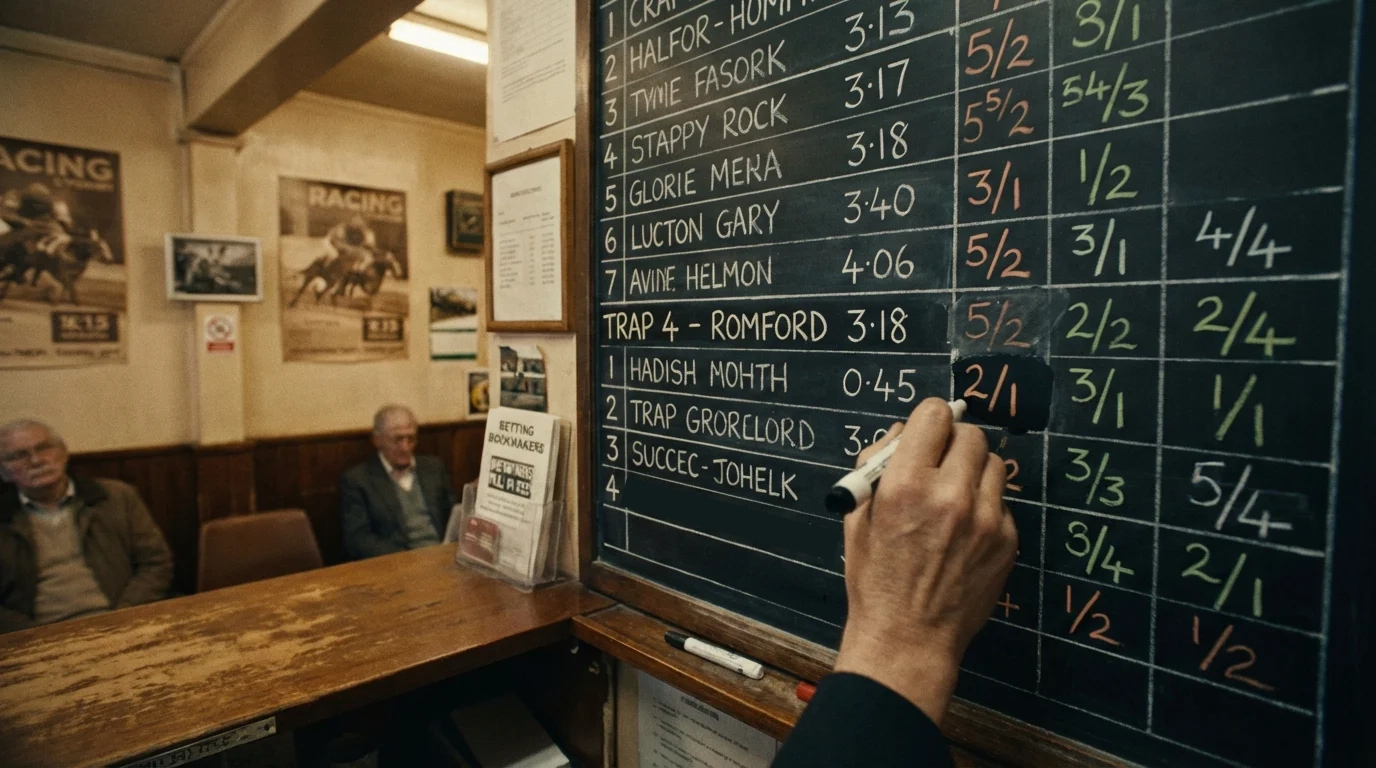
Odds in ante-post greyhound markets are not fixed. They move — sometimes gradually over weeks, sometimes sharply overnight — in response to new information, money flow, and shifts in market sentiment. A dog priced at 33/1 when the English Derby ante-post market opens in April might be 12/1 by the time the first heats are drawn in June, or it might have drifted to 50/1. The direction and speed of that movement contain information that, if you know how to read it, can sharpen your ante-post decisions.
But odds movement can also mislead. Not every price shift reflects genuine information about a dog’s chances. Some movements are mechanical — the result of bookmaker position management. Some are noise — triggered by a single large bet from a punter with no particular edge. The challenge for ante-post greyhound bettors is distinguishing the signal from the noise, and knowing when a price move should change your view and when it shouldn’t.
This article breaks down what drives odds changes in greyhound futures, how to track those changes, and the difference between reacting to price movement and predicting it.
What Drives Price Changes in Greyhound Futures
Ante-post greyhound odds move for a narrower set of reasons than horse racing or football markets. The greyhound futures market is thinner — fewer bookmakers offer it, fewer punters bet into it, and the information flow is more concentrated. This means individual factors can move prices disproportionately.
Trial results are the single biggest driver of ante-post greyhound price changes. When a dog posts a fast trial time at the venue where a major event will be held — particularly Towcester for the Derby — bookmakers adjust their prices immediately. A dog that trials in 28.90 seconds over 500m at Towcester when the best recent Derby winning time was 29.20 will see its odds shorten dramatically, often by a factor of two or three, within hours of the time being recorded. Trial times are public information — they’re reported by the Racing Post, circulated on social media, and available through track contacts — so the market moves quickly once the data is out.
Injury news is the second major driver, and it works in both directions. A reported injury to a fancied dog will see its own odds lengthen (or it may be suspended from the market entirely), while the remaining contenders’ odds often shorten to fill the gap in the book. Conversely, a dog returning from a minor layoff with a strong performance at its home track can trigger a price shortening if the market had assumed the injury was more serious than it was.
Money flow is the third driver, and the most ambiguous. When a significant amount of money is placed on a single dog in an ante-post market, the bookmaker shortens that dog’s odds to manage their liability. In horse racing, where markets are deep and liquid, a single bet rarely moves the price noticeably. In ante-post greyhound markets, where the total amount wagered is much smaller, a single £500 bet can move a dog from 33/1 to 20/1. The question is always: does the money represent informed opinion, or is it just a large bet from someone who likes the dog’s name?
Trainer and kennel activity provides indirect price signals. If a prominent trainer like Graham Holland or Liam Dowling enters multiple dogs from their kennel into a competition, the market may shorten on their most fancied entry while lengthening on their secondary runners. Kennel entries are public, published in advance of the competition, and closely watched by both bookmakers and serious punters. A trainer who enters six dogs has six chances of winning — but the ante-post market will try to determine which of those six the trainer considers the primary hope, and the odds will reflect that assessment.
Finally, bookmaker position management creates price movement that has nothing to do with the dog’s chances. If a bookmaker has taken significant liability on one selection, they’ll shorten its odds to discourage further bets on it, and they may lengthen odds on less popular selections to attract balancing money. This is housekeeping, not information. It can be difficult to distinguish from genuine information-driven movement, but one clue is whether the price change appears at a single bookmaker or across the market. A move at one firm is likely positional. A move across all firms simultaneously suggests new information that everyone is reacting to.
How to Track and Interpret Odds Shifts
Tracking odds movement in ante-post greyhound markets requires different tools and a different mindset than tracking day-of-race price changes. The timescale is weeks rather than minutes, and the data points are sparser.
Oddschecker is the primary tool for most UK-based punters monitoring ante-post greyhound odds. Its greyhound ante-post section displays current prices across all bookmakers offering markets on a given event, and it flags recent price changes with directional arrows. The key feature for odds movement analysis is the price history: you can see how a dog’s odds have changed over time at each bookmaker, which lets you identify trends rather than reacting to a single snapshot.
The Racing Post provides ante-post odds alongside editorial commentary that can contextualise price changes. When a dog’s price shortens after a trial, the Racing Post will often report the trial result alongside the market movement, giving you the causal link between the information event and the price change. This is valuable because it helps you distinguish informed movement (price changes driven by verifiable new data) from speculative movement (price changes driven by money without an obvious information trigger).
Betfair’s exchange markets, where they exist for greyhound ante-post, provide a different kind of signal. Exchange prices reflect the balance of back and lay opinions rather than a bookmaker’s assessment. If a dog is trading at 20/1 on the exchange but 14/1 with bookmakers, the exchange market is signalling that informed money considers the dog less likely than the bookmakers’ price suggests. Conversely, if the exchange price is shorter than the best bookmaker price, there may be value in the bookmaker market. Exchange liquidity for greyhound ante-post is thin, so interpret these signals cautiously — a single large trade can distort the exchange price significantly.
Social media and greyhound racing forums (GreyhoundStar, RPGTV comment sections, specialist Twitter accounts) are early indicators of information that hasn’t yet reached the wider market. Trial results, injury updates, and kennel whispers often circulate in these communities before they appear in official reporting. If you see multiple credible sources discussing a dog’s impressive trial performance and the odds haven’t yet moved, there may be a window to act before the market adjusts. That window is typically short — hours rather than days — because bookmaker traders monitor the same sources.
When interpreting odds shifts, the most useful framework is to ask three questions. First: what new information could explain this move? If you can identify a specific trial result, injury report, or entry change, the movement is likely rational and the new price is probably more accurate than the old one. Second: is the move consistent across bookmakers? If three firms all shorten the same dog on the same day, the information driving the change is broadly accepted. If only one firm moves, it may be positional. Third: does the movement create value elsewhere? When a favourite shortens dramatically, the rest of the field lengthens. Sometimes that lengthening overshoots, creating value on other dogs whose actual chances haven’t changed but whose odds have drifted because the market needed to rebalance.
Reacting vs Predicting Price Movement
There are two fundamentally different approaches to using odds movement in ante-post greyhound betting, and most punters conflate them.
The reactive approach treats odds movement as a confirmation signal. You’ve already done your form analysis and identified a dog you like. When the market moves in your direction — the dog’s odds shorten — you take it as validation that others have reached the same conclusion. When the market moves against you — the odds lengthen — you reassess, asking whether the market knows something you don’t. This approach is sensible, conservative, and appropriate for most punters. It uses odds movement as a sanity check, not as the primary basis for a bet.
The predictive approach tries to anticipate odds movement before it happens, betting into a price that you believe will shorten. This is harder, riskier, and more rewarding when it works. Predicting price movement in ante-post greyhound markets requires you to identify information that the market hasn’t yet priced in — a trial result that hasn’t been widely reported, a dog transitioning from lower grades that most punters haven’t noticed, or a trainer pattern (entering a particular type of dog into a particular event) that historically precedes a strong campaign.
The predictive approach is where the genuine edge exists in ante-post greyhound betting, because the markets are thin enough that information asymmetries persist longer than they do in more liquid markets. A horse racing ante-post market absorbs new information in minutes. A greyhound ante-post market may take hours or days, because fewer participants are watching, fewer bookmakers are adjusting prices, and the information channels are narrower. If you’re one of the first to recognise a significant form update, you can bet into a price that hasn’t yet adjusted — and when it does adjust, your bet is already at the old, more favourable price.
The risk of the predictive approach is that you may be wrong about the information’s significance, or the market may have already priced it in through channels you didn’t observe. A price that looks too long might be too long because you’re ahead of the market — or because you’re missing something the market has already factored in. Distinguishing between these two scenarios is what separates profitable ante-post bettors from those who consistently buy into the wrong side of the movement.
The Signal Under the Noise
Odds movement in ante-post greyhound markets tells a story, but like most stories, it requires interpretation. A shortening price is not inherently good news for backers — it means you’re getting worse value than you would have earlier. A lengthening price is not inherently bad — it might create an opportunity where none existed before. The movement itself is neutral. What matters is whether you can identify the cause, assess whether the new price is justified, and decide whether the change creates or destroys value relative to your own assessment.
The punters who profit from ante-post greyhound odds movement are the ones who watch the market consistently — not obsessively, but attentively — and build a mental model of where prices should be based on form, fitness, and competition structure. When the market price diverges from their model, they act. When it aligns, they wait. The signal is always there, buried under the noise of positional moves, speculative punts, and random fluctuations. Finding it requires patience, pattern recognition, and the discipline to ignore the movements that don’t matter.
