

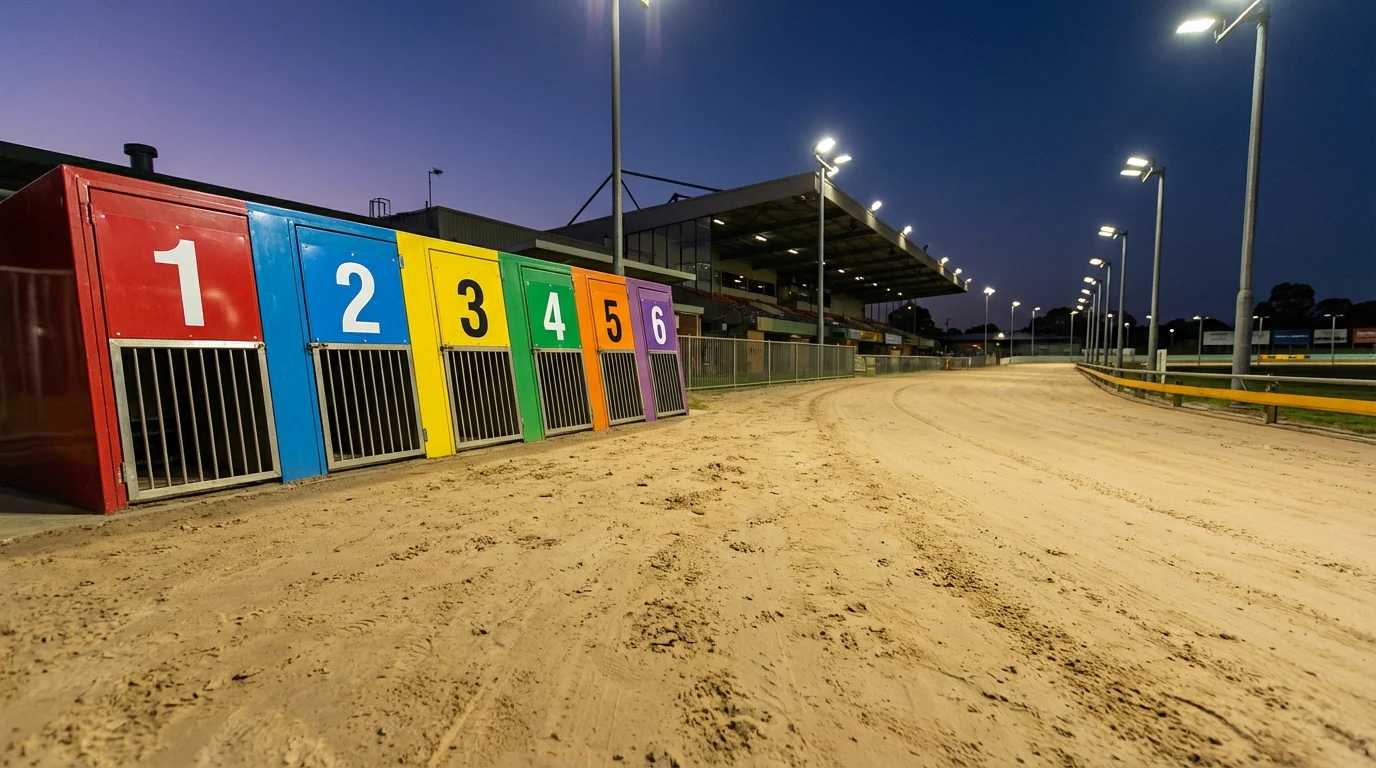
Every greyhound race starts from traps numbered one to six. Trap one is on the inside rail, trap six on the outside, and the positions in between offer varying degrees of advantage depending on the track layout, the dog’s running style, and the composition of the field. In day-of-race betting, the trap draw is a known quantity — you can see which box your dog has been allocated and adjust your assessment accordingly. In ante-post betting, the trap draw for any given heat, quarter-final, or final hasn’t been determined yet. It’s an unknown variable sitting inside every futures price.
That unknown is not random. Trap draw statistics at every UK greyhound track show persistent biases — some traps win more often than others, and the magnitude of those biases varies by track, distance, and race category. A dog that races best from wide draws facing multiple heats at a track where inside traps dominate is carrying a structural disadvantage that the ante-post market may or may not have priced in. Understanding trap draw dynamics doesn’t guarantee you’ll pick the winner, but it does help you assess whether the market price reflects the full picture of a dog’s chances.
Why Trap Draw Matters in Greyhound Racing
Greyhound racing is a sport where the first bend often determines the outcome. The six dogs break from their traps simultaneously and funnel toward the first bend within two to three seconds. Whichever dog reaches that bend first, or reaches it in a position where it can run cleanly, has a significant advantage for the remainder of the race. The trap draw directly influences where each dog is positioned in that critical opening phase.
Dogs in trap one — the inside box — have the shortest route to the first bend on tracks with standard bends. They don’t need to cross any other runner’s path, and if they have decent early pace, they can establish position on the rail and control the race from the front. This is why trap one has a statistically higher win rate at most UK tracks. The advantage is physical: shorter distance to the bend, cleaner racing line, less interference.
Trap six — the outside — has the longest route to the first bend but offers a different kind of advantage: clear running room. A dog from trap six doesn’t risk being squeezed or checked by dogs converging from its inside. If it has enough early pace to hold its position wide through the first bend, it can then angle in toward the rail on the back straight without traffic interference. For dogs with raw speed but poor crowding tolerance, the outside draw can be the best possible starting position.
The middle traps — two through five — are the most variable and the most dependent on the specific track configuration. At some venues, trap two performs almost as well as trap one because the angle to the first bend allows the inside pair to work together without interference. At others, the middle traps are consistently disadvantaged because dogs from those boxes face traffic from both sides and have neither the inside rail nor the outside space to work with.
What makes this relevant to ante-post betting is the dog’s trap-draw versatility. A greyhound that performs well regardless of its box position is a more reliable ante-post selection than one that excels from a specific trap. Over a multi-round knockout tournament, a dog will likely be drawn in different traps at different stages. If its form drops sharply from middle draws, it only needs one unfavourable box allocation to end its tournament run — and your ante-post bet with it.
Trap Statistics at Major UK Tracks
Trap draw statistics are publicly available through the Racing Post, specialist greyhound data sites, and some bookmaker platforms. The data covers thousands of races at each venue and reveals persistent patterns that serious ante-post bettors should be aware of for the tracks hosting major events.
All greyhound racing in the UK takes place on sand surfaces, though conditions vary by venue, weather, and maintenance. Towcester, the home of the English Greyhound Derby since its move from Wimbledon in 2017, produces trap statistics that are essential reading for Derby ante-post bettors. The track’s configuration — a sweeping circuit with relatively long straights — has historically favoured dogs with strong early pace from inside draws. Trap one and trap two at Towcester over the standard 500m distance show win rates consistently above what random chance would predict, while the middle traps (three and four) tend to underperform. Trap six has a more balanced record than at many tracks, because Towcester’s wider bends give outside runners more room to hold their position.
Shelbourne Park, where the Irish Greyhound Derby is held, also uses a sand-based surface, but the specific composition and track geometry differ from UK venues like Towcester. The surface affects trap bias because dogs grip and accelerate differently depending on the track’s sand blend and maintenance regime. Shelbourne’s 550-yard trip starts with a longer run to the first bend than Towcester’s 500m layout, which slightly reduces the inside-trap advantage — dogs from wider draws have more time to establish position before the bend. Historical data at Shelbourne shows a flatter distribution of wins across traps than Towcester, with trap one still leading but by a smaller margin.
Nottingham, the host of the 2025 Greyhound St Leger (the race was previously held at Perry Barr over 710m from 2017 to 2024), has its own trap profile influenced by the 730m distance. Over longer distances, the first-bend advantage is diluted because there are more bends in total and more opportunities for dogs to make positional adjustments. Trap draw statistics at Nottingham over the St Leger distance show less variation between boxes than the same track’s sprint distances, which is consistent with the principle that stamina events reduce the impact of the start.
Other tracks hosting Category One events carry their own biases. Hove, Monmore, and Romford each have distinct configurations — tight bends, short straights, or unusual trap-to-bend angles — that produce identifiable trap patterns. When a dog that primarily races at Hove (a tight track with pronounced inside-trap bias) enters the Derby at Towcester, its home-track form from trap one may overstate its ability to perform from a middle or outside draw at a different venue. This is the kind of adjustment that the ante-post market sometimes makes and sometimes doesn’t, depending on how closely the pricing reflects venue-specific form.
The practical takeaway: before backing a dog in an ante-post greyhound market, check its form across different trap draws. A dog that has raced predominantly from trap one or trap two and posted its best times from those positions may see its performance drop when drawn elsewhere in a tournament heat. Conversely, a dog with competitive times from traps three through six may be underpriced because its overall record looks less impressive than a specialist inside runner — even though its trap versatility makes it better suited to the unpredictable draws of a knockout competition.
How Trap Draw Knowledge Improves Ante-Post Picks
Trap draw analysis in ante-post greyhound betting is not about predicting which trap a dog will draw in a future race. That’s unknown and unknowable when you place the bet. Instead, it’s about assessing how a dog’s performance varies with trap position and factoring that variation into your estimate of its overall chances across a multi-round tournament.
The first application is identifying trap-dependent dogs that the market may be overpricing. A dog with ten recent wins — eight from trap one, two from trap two — looks like a dominant runner on paper. Its ante-post price may reflect that win record. But in a Derby with six rounds of racing, the probability of being drawn in trap one for every round is negligible. In several of those rounds, the dog will race from traps three, four, or five, where its record is either weak or non-existent. The market price based on its headline win rate may not adequately discount this trap dependency, creating an opportunity to lay or avoid the dog rather than back it.
The second application is identifying trap-versatile dogs that the market may be underpricing. A dog with a moderate win rate — say, 40% — but consistent finishing positions across all six trap draws is a more robust tournament competitor than its overall strike rate suggests. Its ante-post odds may be longer than justified because the headline figures don’t distinguish between performance by trap. This is where digging into the form data — filtering results by trap draw, not just aggregating them — reveals value that casual analysis misses.
The third application is track-specific trap assessment. If you’re betting ante-post on the English Derby, the relevant trap data is Towcester-specific. A dog that handles inside draws well at Towcester has a structural advantage in the Derby that a dog with inside-draw success at Romford doesn’t necessarily share, because the two tracks have different geometries. Filtering form not just by trap but by venue — or by venues with similar configurations — produces a more accurate ante-post assessment than using aggregate data across all tracks.
Finally, trap draw knowledge helps with in-tournament hedging. Once the heats are drawn and you can see your ante-post selection’s box position for each round, you can assess whether the draw is favourable or unfavourable relative to the dog’s trap profile. A bad draw in the first round doesn’t mean your bet is dead, but it changes the probability of progression — and if you have access to cash-out or exchange markets, that updated probability may inform a hedging decision.
Six Boxes, Six Stories
Trap draw is one of those factors in greyhound racing that every experienced punter knows about and most ante-post bettors underweight. It’s easy to focus on time figures, grade progression, and trainer records — the big, visible data points that dominate form analysis. The trap draw is smaller, quieter, and harder to quantify in a single number. But over the course of a six-round knockout tournament, the cumulative effect of trap-draw variation is significant enough to separate the dogs that make the final from the ones that fall in the heats.
When you’re evaluating an ante-post greyhound selection, the question isn’t whether the dog can win from trap one. Most decent dogs can. The question is whether it can compete from trap four, or trap five, or the outside box — because at some point in the tournament, it will have to. The dogs whose form holds up regardless of the draw are the ones whose ante-post prices carry the most substance. Everything else is a bet on luck as much as ability.
