

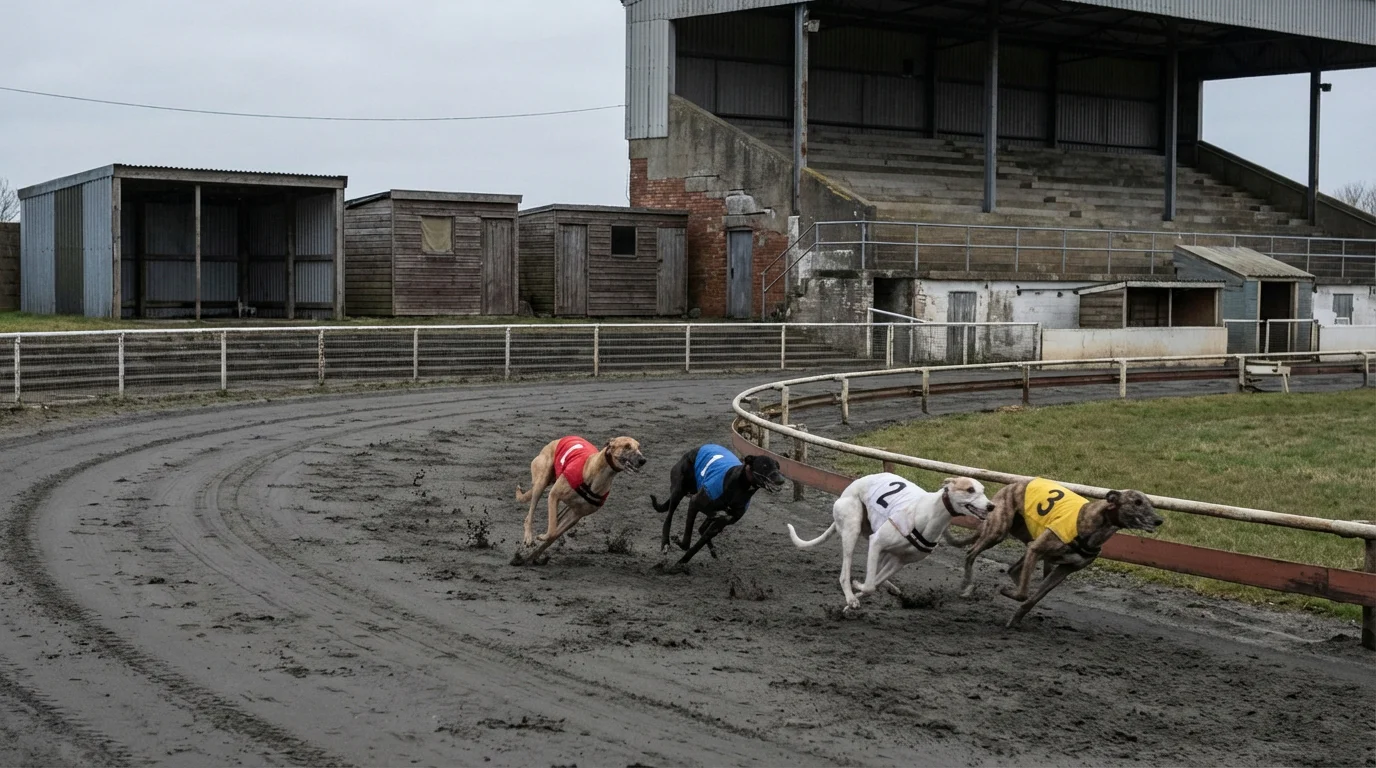
If you follow UK greyhound racing through bookmaker platforms, the majority of meetings you’ll encounter are BAGS or BEGS fixtures. These are the afternoon and evening meetings that run six or seven days a week, providing a continuous flow of races for betting shops and online customers. They account for the vast majority of greyhound races run in the UK each year, and they generate the bulk of the betting turnover that keeps the sport financially viable.
For punters interested in ante-post greyhound betting, BAGS and BEGS meetings occupy a peculiar position: they’re everywhere in day-of-race betting but almost entirely absent from futures markets. Understanding why — and what that means for your ante-post strategy — requires understanding what these meetings actually are, how they differ from the events that do carry ante-post odds, and whether the gap between daily racing and futures markets is likely to change.
What Are BAGS and BEGS Meetings?
BAGS stands for Bookmakers’ Afternoon Greyhound Service. It’s a contractual arrangement between greyhound tracks and the betting industry that provides a scheduled programme of afternoon races specifically designed for off-course betting. BAGS meetings run at multiple tracks simultaneously throughout the afternoon, typically starting around 11am and continuing until early evening. The races are broadcast via data feeds and live streaming to betting shops and online platforms, giving punters a rolling schedule of greyhound races to bet on throughout the day.
BEGS — the Bookmakers’ Evening Greyhound Service — is the equivalent programme for evening meetings. BEGS fixtures fill the prime-time slot from around 6pm onwards, overlapping with the period when betting shops close but online platforms continue to trade. Between BAGS and BEGS, there is greyhound racing available for betting during virtually every waking hour, every day of the week.
The commercial model behind BAGS and BEGS is straightforward. Bookmakers pay fees to greyhound tracks for the right to offer betting on these meetings. In return, the tracks provide a consistent schedule of races with predictable field sizes (usually six runners) at standard distances. The arrangement benefits both sides: bookmakers get content to fill their schedules and generate turnover, while tracks receive guaranteed media rights income that supplements gate receipts and prize money.
The racing itself is graded. Dogs compete within their ability band — A1 through A11, with A1 being the highest standard — and are promoted or relegated based on their results. The quality of racing at BAGS and BEGS meetings varies significantly depending on the grade. Top-graded races (A1 and A2) at venues like Monmore, Nottingham, and Hove can feature genuinely talented dogs that might be contenders for open races or Category One events. Lower grades serve a different purpose: competitive races for dogs of lesser ability, keeping the racing card full and the betting turnover flowing.
What BAGS and BEGS meetings do not have, in nearly all cases, is an ante-post market. Bookmakers offer day-of-race odds on these meetings — you can bet on the next race at Romford or the 8pm at Monmore right up until trap rise — but they don’t offer futures prices on individual BAGS or BEGS fixtures weeks or months in advance. The reasons for this are structural and commercial, and they illuminate exactly what makes certain greyhound events different enough to carry ante-post odds.
Ante-Post Markets and Graded Racing
Ante-post markets exist for greyhound events that meet specific criteria: the event runs over multiple rounds (knockout format), the field is large enough that the outcome is genuinely uncertain weeks in advance, the competition attracts the best dogs in the country, and there is sufficient public interest to generate meaningful betting volume on the futures market. These criteria describe Category One events — the English Derby, the Irish Derby, the St Leger, and a handful of others — not BAGS or BEGS meetings.
A typical BAGS meeting features six or seven individual races, each with a six-dog field drawn from the track’s graded population. The races are standalone events, not part of a multi-week tournament. There is no bracket, no progressive elimination, no mounting tension over rounds. Each race is self-contained: the six dogs are declared the day before, the odds open on the morning of the meeting, and the race is settled within thirty seconds of the traps opening. The entire information cycle — from field declaration to result — is complete within 24 hours.
This compression is why BAGS meetings don’t carry ante-post markets. Ante-post pricing requires enough lead time for uncertainty to generate a meaningful odds differential between early and late bets. When the field is known the day before and the race happens the next afternoon, there’s no window for the kind of information evolution that makes futures betting commercially interesting for bookmakers or strategically useful for punters.
There’s also a demand issue. BAGS and BEGS races are high-frequency, low-profile events. No individual race at a Tuesday afternoon meeting at Crayford generates enough public interest to sustain a futures market. The cumulative turnover across hundreds of BAGS races per week is enormous, but it’s distributed across individual day-of-race bets, not concentrated on any single event. Bookmakers allocate their trading resources where the volume justifies it, and BAGS futures doesn’t clear that threshold.
The exception — partial and conditional — is when a BAGS or BEGS meeting features an open race or a significant competition that sits above the normal graded structure. Some tracks host open-race nights or feature events with enhanced prize money and invitational fields. These events occasionally generate enough interest for a bookmaker to offer early prices, though the lead time is typically days rather than weeks and the market structure is closer to next-day racing prices than true ante-post.
Category One Events vs BAGS Coverage
The distinction between Category One events and BAGS racing is the dividing line of ante-post greyhound betting. On one side: the major tournaments that generate futures markets, attract national media coverage, and sustain ante-post betting activity for weeks. On the other: the vast daily schedule of graded racing that generates enormous day-of-race turnover but no futures market at all.
Category One events in UK and Irish greyhound racing number roughly a dozen per year. The English Derby, Irish Derby, St Leger, Scottish Derby, Pall Mall, Cesarewitch, and Select Stakes are the headline fixtures, with several others rotating in and out of the calendar. These events are distinguished by their prize money, their prestige, their multi-round tournament format, and the quality of the dogs entered. They are the greyhound equivalent of horse racing’s Classic races — the events that define a dog’s career and a trainer’s reputation.
For ante-post bettors, Category One events are the entire market. Every ante-post greyhound bet you place — every futures price you take, every non-runner risk you accept, every each-way punt you consider — is tied to one of these events. The BAGS schedule, despite being far larger in terms of total racing volume, sits entirely outside the ante-post framework.
This has a practical implication for how you use BAGS racing in your ante-post strategy. BAGS meetings don’t carry futures odds, but they’re where many of the dogs that will eventually enter Category One events do their day-to-day racing. A dog competing in A1 graded races at BAGS meetings throughout March and April is producing the form data that informs your ante-post assessment for the English Derby in June. The BAGS schedule is the research ground, even though it’s not the betting ground for futures purposes.
Watching BAGS meetings — through live streaming or form data — is how ante-post bettors identify dogs whose trajectory suggests they’ll be competitive in a major event. A dog rising from A3 to A1 at Towcester in the months before the Derby, posting improving times and showing trap versatility, is exactly the kind of form signal that precedes a market-moving ante-post price change. You’re not betting on the BAGS meetings themselves, but you’re using the information they generate to inform your bets on the Category One events that do carry ante-post markets.
The reverse is also useful: BAGS form can tell you when a fancied ante-post selection is underperforming. A dog that looked strong in January form and was backed in the Derby ante-post market at 16/1 but is now losing graded races at its home track in April is sending a warning signal. The ante-post price may not have adjusted yet — particularly if the graded losses are at a BAGS meeting that casual ante-post bettors aren’t watching — which means the information asymmetry works in your favour if you’re monitoring the daily racing schedule.
The Afternoon Market’s Missing Piece
BAGS and BEGS racing is the backbone of UK greyhound betting — the constant, daily output that keeps the sport commercially viable and the betting product alive. It serves its purpose well: a reliable, high-frequency schedule that gives punters something to bet on every afternoon and evening. But it exists in a completely different dimension from ante-post greyhound betting, and conflating the two leads to misunderstanding about where futures odds come from and what they apply to.
If you’re an ante-post greyhound bettor, BAGS isn’t your market. It’s your classroom. The dogs race there, the form accumulates there, and the signals that tell you who’s ready for a major event emerge there. The ante-post bets themselves go on the Category One events — the tournaments where the prize money justifies the preparation, the field quality justifies the uncertainty, and the public interest justifies the bookmaker maintaining a futures book. Understanding that distinction is the first step toward using both halves of the greyhound schedule to your advantage.
