

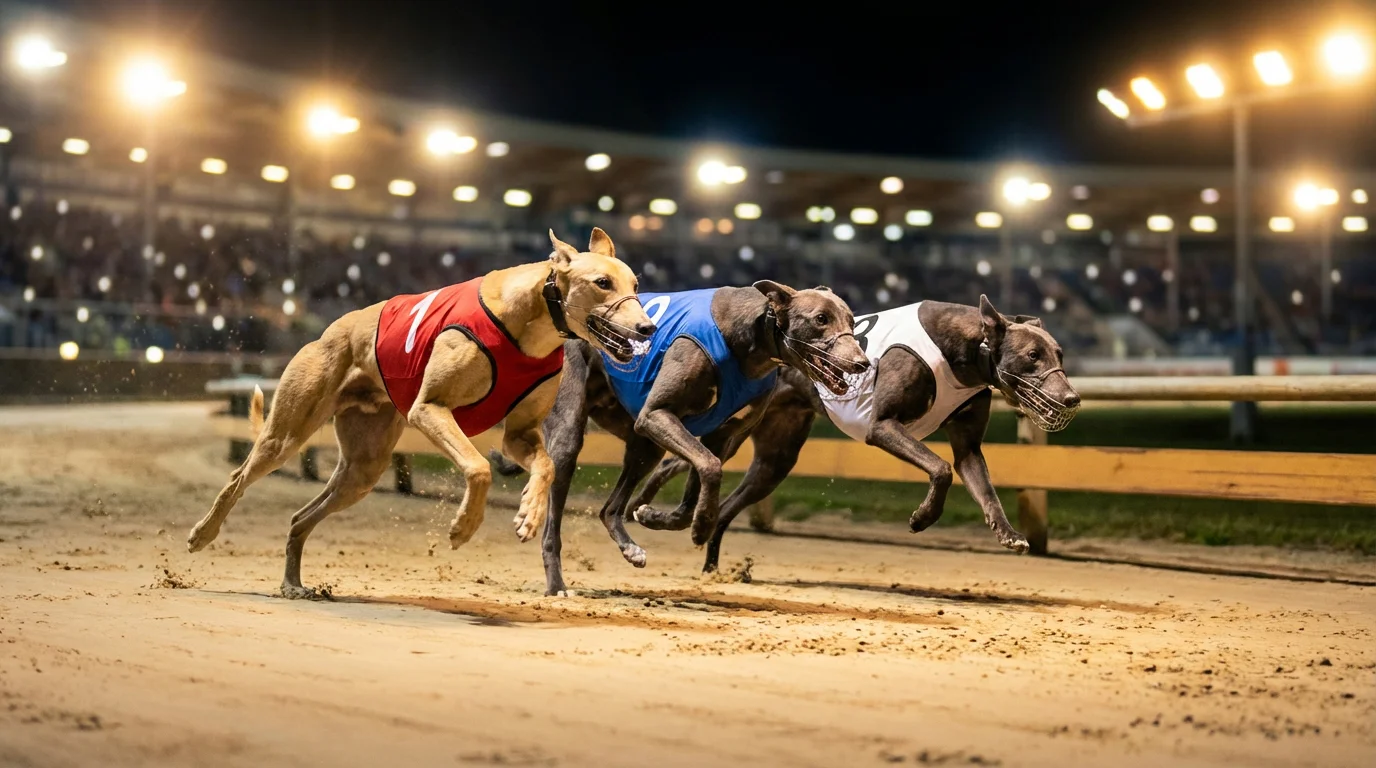
Forecasts and tricasts are among the most popular bet types in day-of-race greyhound betting. A forecast asks you to predict the first and second-place finishers in the correct order. A tricast extends that to first, second, and third. Both offer larger returns than a simple win bet because predicting the exact finishing order is significantly harder than picking one winner, and the odds reflect that difficulty.
In day-of-race greyhound markets, forecasts and tricasts are standard offerings — available on every race, at every track, from every bookmaker. In ante-post greyhound markets, the picture is entirely different. Forecasts and tricasts are either unavailable or so heavily restricted that they barely exist as a practical option for futures bettors. This absence is not an oversight. It reflects structural features of ante-post markets that make multi-place predictions commercially unworkable for bookmakers and mathematically questionable for punters.
This article explains why forecasts are largely absent from ante-post greyhound markets, why tricasts are even more constrained, and what alternatives exist for punters who want to bet on multiple outcomes in greyhound futures.
Are Forecasts Available in Ante-Post Markets?
The short answer is: almost never. Forecasts — predicting the first and second-place finisher in a specific order — are not a standard feature of ante-post greyhound markets at any major UK bookmaker. You won’t find a forecast option on Bet365’s English Derby ante-post page, or on Paddy Power’s Irish Derby futures market, or on William Hill’s St Leger book. The betslip simply doesn’t offer it.
The reason is structural. A day-of-race greyhound forecast works because the field is defined: six dogs, each with a known trap draw, running a single race in a few minutes. The bookmaker can calculate a forecast dividend based on the six-dog field using a computer straight forecast (CSF) formula that weights the odds of each finishing combination. The calculation is contained, the variables are fixed, and the result is deterministic once the race finishes.
An ante-post forecast on, say, the English Derby final would require predicting not just which dog wins but which dog finishes second — in a final whose composition is unknown. The six dogs in the final won’t be determined until the semi-finals are complete, which is itself weeks away when the ante-post market opens. Pricing a forecast when you don’t know which six dogs will be in the race — let alone their form, fitness, and trap draws on the night — is a pricing problem that bookmakers have no reliable model for. The uncertainty isn’t quantifiable within the margins that make a market commercially viable.
There’s also a demand problem. Forecast betting is popular in day-of-race greyhound markets because the short fields and fast races make it feel accessible — only six dogs, how hard can it be to get the first two right? In ante-post markets, the perceived difficulty jumps dramatically. Punters who are already accepting non-runner risk and months of waiting for a win bet are generally not looking to add the complexity of predicting second place in a race that hasn’t been constituted yet.
Some bookmakers have occasionally offered promotional forecast-style markets on high-profile greyhound events — typically as one-offs rather than permanent features. These might take the form of “name the first and second in the Derby final” with fixed odds set by the trading team rather than calculated through a CSF formula. When these appear, the odds offered are typically conservative because the uncertainty premium is enormous and the bookmaker has no established model for pricing the market accurately. They’re novelty bets rather than serious forecasting opportunities.
If you encounter an ante-post forecast market on a greyhound event, examine the terms carefully. Check whether the forecast applies only to the final or to any round. Confirm whether non-runner rules apply to both selections or just the first. And compare the effective odds to what you’d get from two separate win bets — because in many cases, two singles offer better expected value than a forecast with the bookmaker’s uncertainty premium baked into the price.
Tricast Limitations in Greyhound Futures
If forecasts are rare in ante-post greyhound markets, tricasts are essentially non-existent. The logic that makes forecasts impractical — unknown final composition, unquantifiable uncertainty, no reliable pricing model — applies with even greater force to tricasts, where you’re predicting first, second, and third in the correct order.
The mathematics make the case clearly. In a six-dog greyhound final, there are 120 possible tricast combinations (6 × 5 × 4). In an ante-post market where the final field is unknown, the number of potential tricast combinations across all plausible finalists is orders of magnitude larger. If 30 dogs are in the ante-post market and any six could make the final, the number of possible tricast outcomes across all possible final compositions runs into thousands. No bookmaker has the data, the models, or the commercial incentive to price that space.
Even if a bookmaker were to offer an ante-post tricast on a greyhound event, the odds would need to compensate for such extreme uncertainty that the resulting prices would be astronomically long — and the bookmaker’s margin would need to be correspondingly large to protect against mispricing. The result would be a bet with a huge potential payout, a minuscule probability of collection, and an expected value so negative that it would make a lottery ticket look like a prudent investment.
Computer tricast formulas, which are used to settle day-of-race tricast bets, require the starting prices of all runners in a defined field. In ante-post markets, there are no starting prices and no defined field. The formula simply can’t be applied. Any ante-post tricast would need to be offered at fixed odds set by the bookmaker’s trading team — a manual pricing exercise that, for the reasons outlined above, no trader wants to undertake.
The closest thing to a tricast in greyhound futures is a combination of separate ante-post bets — backing one dog to win and others to reach the final — but this isn’t a tricast in any meaningful sense. It’s multiple independent bets with separate settlement conditions, and it doesn’t require predicting the exact finishing order. For punters who want the thrill of a multi-place prediction in greyhound racing, the day-of-race markets are where that product exists. In ante-post, the question of finishing order beyond first place is simply not part of the available market structure.
Alternatives for Multi-Place Ante-Post Wagers
The absence of forecasts and tricasts in ante-post greyhound markets doesn’t mean you’re limited to straight win bets. Several alternative bet types allow you to engage with multiple outcomes in a greyhound futures context, even though none of them replicate the exact mechanics of a forecast or tricast.
Each-way betting is the most straightforward alternative. An each-way ante-post bet pays on both the win and a place finish — typically first or second in the final. It’s not a forecast, because you’re not predicting the exact finishing order, but it gives you a return on a second-place finish that a win-only bet doesn’t. If your analysis suggests a dog is likely to reach the final but might not be the strongest runner in it, an each-way bet captures that view. The place terms (usually one-quarter the odds) mean the place return is significantly smaller than the win return, but it’s better than nothing on a dog that finishes second.
Multiple single bets offer another approach. Instead of a forecast predicting first and second, you can back two dogs in the same event with separate win bets. If either wins, you profit. If both make the final, you’re exposed to two of the six runners — a 33% coverage rate — without needing to predict the order. This is more expensive than a single forecast (you’re paying two stakes), but it avoids the forecast pricing premium and gives you flexibility: you can stake different amounts on each dog based on your assessment of their relative chances.
Without-the-favourite markets, when available, offer an indirect way to bet on a specific finishing position. A “without” market removes the favourite (or the top two) from the betting and pays out on the highest finisher among the remaining dogs. This isn’t widely offered in ante-post greyhound markets, but it appears occasionally on the English Derby and can be used to bet on dogs you think will place highly without needing to predict the overall winner.
Betting exchange markets provide the most flexibility for constructing multi-place positions. On Betfair, you can back one dog and lay another — effectively betting that Dog A will finish ahead of Dog B. While this isn’t a formal forecast, it creates a position that profits from a specific relative finishing order. Exchange liquidity on greyhound ante-post is thin, so this approach works best for smaller stakes, but it’s the closest available equivalent to a forecast mechanism in the futures space.
Finally, accumulators across multiple events — backing different dogs in different competitions — offer big-odds multi-selection bets without the forecast structure. You’re not predicting finishing order within a single race, but you’re combining multiple low-probability outcomes into a single high-payout bet, which is what draws most punters to forecasts and tricasts in the first place.
Predicting Two Steps Ahead
The reason forecasts and tricasts don’t exist in ante-post greyhound markets is simple: the uncertainty is too deep. You’re already making a prediction about who will win an event whose field, draw, and conditions are unknown. Adding a prediction about who finishes second — in a race that might not include any of the dogs you’re considering — stacks uncertainty on uncertainty to the point where the bet becomes untetherable to any rational analysis.
That doesn’t make the desire unreasonable. Punters who enjoy forecasts enjoy the challenge of predicting relationships between outcomes, not just single results. But in ante-post greyhound markets, the available tools — each-way bets, multiple singles, exchange positions — let you express multi-outcome views without the impossible pricing problem that formal forecasts would require. The art of ante-post greyhound betting is working within the constraints of what the market offers, not wishing it offered something it structurally cannot.
