

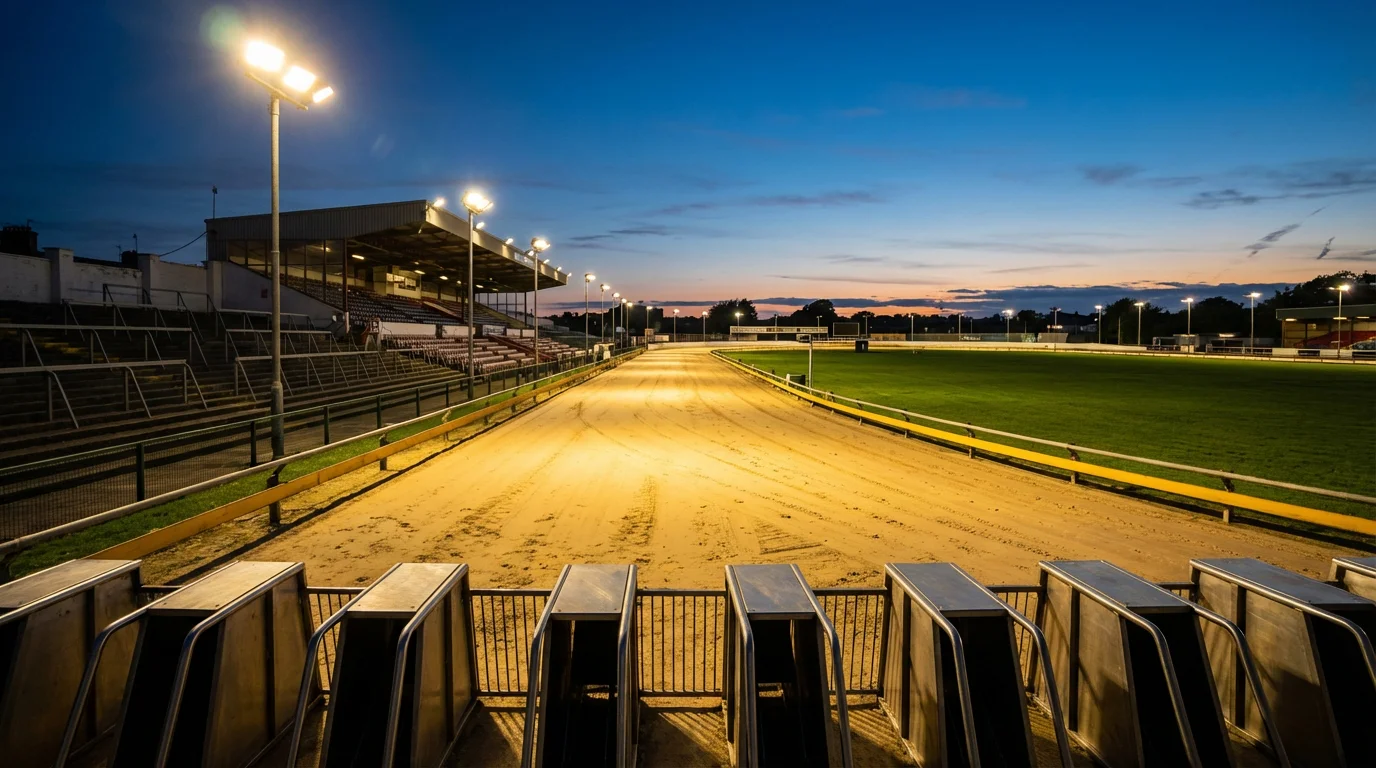
The BoyleSports Irish Greyhound Derby at Shelbourne Park is the second-biggest ante-post market in greyhound racing, sitting just behind the English Derby in terms of betting volume, prestige, and field quality. But the Irish version is not simply a mirror of its English counterpart — it runs on a different surface profile, over a longer distance, and attracts a training pool that brings its own strengths and tendencies to the ante-post equation.
Shelbourne Park’s 550-yard sand track demands qualities that don’t always translate from other venues. Dogs need sustained pace over the extra distance compared to the 500m English Derby. The sand surface plays differently to Towcester’s configuration. And the Irish training culture — with its emphasis on producing dogs that peak for the big nights — creates a competitive dynamic that shapes ante-post prices in ways the English market doesn’t always replicate.
For punters approaching Irish Derby futures, the analysis framework overlaps with the English event but diverges on specifics. This guide covers what makes Shelbourne Park’s format distinctive, how cross-border entries complicate the ante-post picture, and where to find genuine value in a market that can be both thinner and sharper than its English counterpart.
Shelbourne Park Format and Distance
Shelbourne Park runs the Irish Derby over 550 yards on sand, and that combination of distance and surface is the first thing ante-post bettors need to factor into their analysis. The extra 50 yards compared to the English Derby — roughly an additional two seconds of running time — shifts the form criteria. Speed remains essential, but it’s no longer the only currency. Dogs need to carry their pace beyond the initial burst, and the ability to sustain effort through the third and fourth bends separates genuine contenders from flat-track sprinters who fade over the longer trip.
The track at Shelbourne has a reputation for rewarding dogs with tactical intelligence. The traps feed into a bend that can cause bunching, making early pace and trapping ability important — but not as decisive as at tighter circuits. Dogs that can recover from a slow break, or that excel at running on from a mid-race position, have historically done well in the Irish Derby. This matters for ante-post selection because it means you’re not simply looking for the fastest dog over 500m. You’re looking for the dog most likely to handle 550 yards at Shelbourne with the composure to navigate traffic and sustain effort.
The tournament format mirrors the English Derby: heats, subsequent rounds, semi-finals, and a six-dog final. The entry pool is slightly smaller — typically 96 to 128 dogs, compared to around 192 in the English event — which means the knockout path is shorter and less attritional. From an ante-post perspective, this is significant. A smaller starting field reduces the raw probability of your selection being eliminated by bad luck in the early rounds, and it means the ante-post market is pricing a narrower range of outcomes. Prices are generally shorter than equivalent English Derby ante-post markets, but the hit rate for making the final is marginally higher.
Shelbourne Park’s sand surface is standard for Irish greyhound racing, and most dogs entering the Irish Derby will have extensive experience on it. For cross-border entries from the UK — dogs more accustomed to different surfaces — the transition is a known variable. Some UK-trained dogs handle Shelbourne’s sand without issue; others lose a length or two on unfamiliar footing. When evaluating ante-post candidates that have primarily raced in the UK, checking for any prior runs at Shelbourne or on comparable Irish sand tracks is a useful filter.
The Irish Derby final is traditionally held on a Saturday evening, and it’s one of the marquee events in Irish sporting culture. Prize money has fluctuated over the years but remains substantial, contributing to the event’s ability to attract top-quality entries from both Irish and UK kennels. For ante-post purposes, the prestige matters because it ensures the field quality is consistently high — there’s no Derby where the best dogs skip the race.
Cross-Border Entries and Trainer Power
The Irish Derby is an Irish event with a British problem — or opportunity, depending on which side of the Irish Sea you’re standing on. UK-trained dogs routinely enter the competition, and some of the most successful Irish Derby winners in recent years have been prepared by trainers based in England. This cross-border dynamic complicates ante-post analysis because you’re evaluating two different training ecosystems, two different racing circuits, and two different form profiles against each other on the same night.
Irish trainers dominate the entry pool by volume, and the leading Irish kennels tend to be the market leaders when ante-post prices first appear. Graham Holland, whose Newinn-based kennel has produced English Derby winners and Irish Derby contenders in equal measure, is typically among the first names assessed by ante-post traders. Pat Buckley, Liam Dowling, and Dolores Ruth are among other trainers whose entries consistently reach the later stages. Irish trainers have the home advantage of preparing dogs on the same surface and, in many cases, at the same track where the Derby will be decided.
UK entries bring different variables. A dog that has been running at Towcester, Monmore, or Nottingham may arrive at Shelbourne Park with exceptional speed figures but limited experience of the track. Ante-post markets don’t always properly account for this transition risk. A UK-trained dog priced at 10/1 based on its English form might be worth 14/1 or 16/1 once you factor in the surface adjustment and the lack of Shelbourne race experience. Conversely, a UK dog that has trialled well at Shelbourne — or that ran in the previous year’s Irish Derby — is a proven traveller, and the market may undervalue that evidence if it’s buried in the form guide.
The trainer power dynamic also extends to multi-entry strategies. Leading kennels often field three, four, or even five entries in the Irish Derby, spread across different heats. For ante-post bettors, this creates a tempting proposition: instead of backing one dog, you’re effectively betting on a kennel’s chances of getting at least one representative to the final. Some punters spread small ante-post stakes across multiple entries from the same trainer, treating it as a portfolio play on kennel quality rather than individual dog ability. The risk is that you’re multiplying your exposure to the same non-runner scenario — if a kennel withdraws multiple dogs due to injury or illness, you lose on all of them.
Historically, the Irish Derby has been won by Irish-trained dogs more often than not, but the margin is narrower than casual followers might assume. UK entries have taken the title in recent cycles, and the calibre of cross-border entries has risen as the prize money and prestige justify the cost of travelling. For ante-post purposes, don’t default to Irish trainers simply because it’s an Irish race. Evaluate the dogs — wherever they’re trained — on the criteria that matter at Shelbourne: 550-yard form, sand experience, pace sustainability, and trainer competence in major knockout competition.
Finding Value in Irish Derby Futures
Value in the Irish Derby ante-post market tends to sit in a different place than the English equivalent. The market is thinner — fewer bookmakers price it as aggressively, and the odds offered by the firms that do can vary more widely. That variance is where the opportunity lives.
Start by comparing prices across at least four or five bookmakers before placing a bet. BoyleSports, as the event’s title sponsor, typically offers the most comprehensive Irish Derby ante-post market and occasionally runs enhanced odds or NRNB promotions tied to the event. Bet365 and Paddy Power also price the Irish Derby ante-post market, though their offerings may arrive slightly later or with fewer runners listed. Oddschecker’s greyhound ante-post section captures all available prices and is the most efficient comparison tool.
Timing patterns in the Irish Derby ante-post market differ from the English event. Because the Irish racing calendar positions the Derby in the late summer or early autumn — typically September — the ante-post market tends to open in July or August. At that point, the most recent major event data comes from the English Derby (which concludes in June or July), and dogs that performed well at Towcester often appear prominently in Irish Derby ante-post pricing. The market sometimes overreacts to English Derby form, pricing those dogs too short and leaving Irish-trained contenders at longer odds than their domestic form warrants.
This creates a specific value angle: Irish-trained dogs that didn’t enter the English Derby but have been performing strongly in domestic open racing and Category One events during the summer. These dogs may have form that’s equally strong as the English Derby semi-finalists, but they’re priced longer because the market disproportionately weights the form it’s seen most recently — which, at the time Irish Derby ante-post markets open, is English form.
Each-way ante-post betting on the Irish Derby follows the same principles as the English event. Where available, each-way terms typically pay on the first two in the final at one-quarter odds. The smaller starting field means the route to the final is slightly less treacherous, which marginally improves the probability of an each-way return — but the margin is modest, and the reduced odds on the place portion reflect it. Each-way ante-post on the Irish Derby is a reasonable approach if you’ve identified a strong contender but lack conviction that it will win outright. Otherwise, the win-only bet offers a cleaner risk-reward profile.
The Sand and the Signal
Shelbourne Park on a Saturday evening in September, six dogs in the traps, and one of them wearing the number you backed eight weeks ago at 20/1. That’s the Irish Derby ante-post experience at its most intense — the culmination of form research, kennel analysis, and a calculated acceptance of risk that began before the first heat was even drawn.
The Irish Derby ante-post market isn’t as deep or as widely covered as its English counterpart, and that’s precisely what makes it interesting for serious punters. Thinner markets mean wider price discrepancies between bookmakers. Less coverage means fewer casual bettors driving prices to efficient levels. And the cross-border dynamics — the interplay between Irish and UK form, surface familiarity, and trainer strategies — add layers of complexity that reward genuine research over surface-level analysis.
The sand at Shelbourne tells its own story, and the punters who listen to it most carefully tend to hear the signal that others miss. Read the form. Study the kennels. Check the surface. And when the market offers a price that your analysis says is wrong — take it, and wait for September.
