
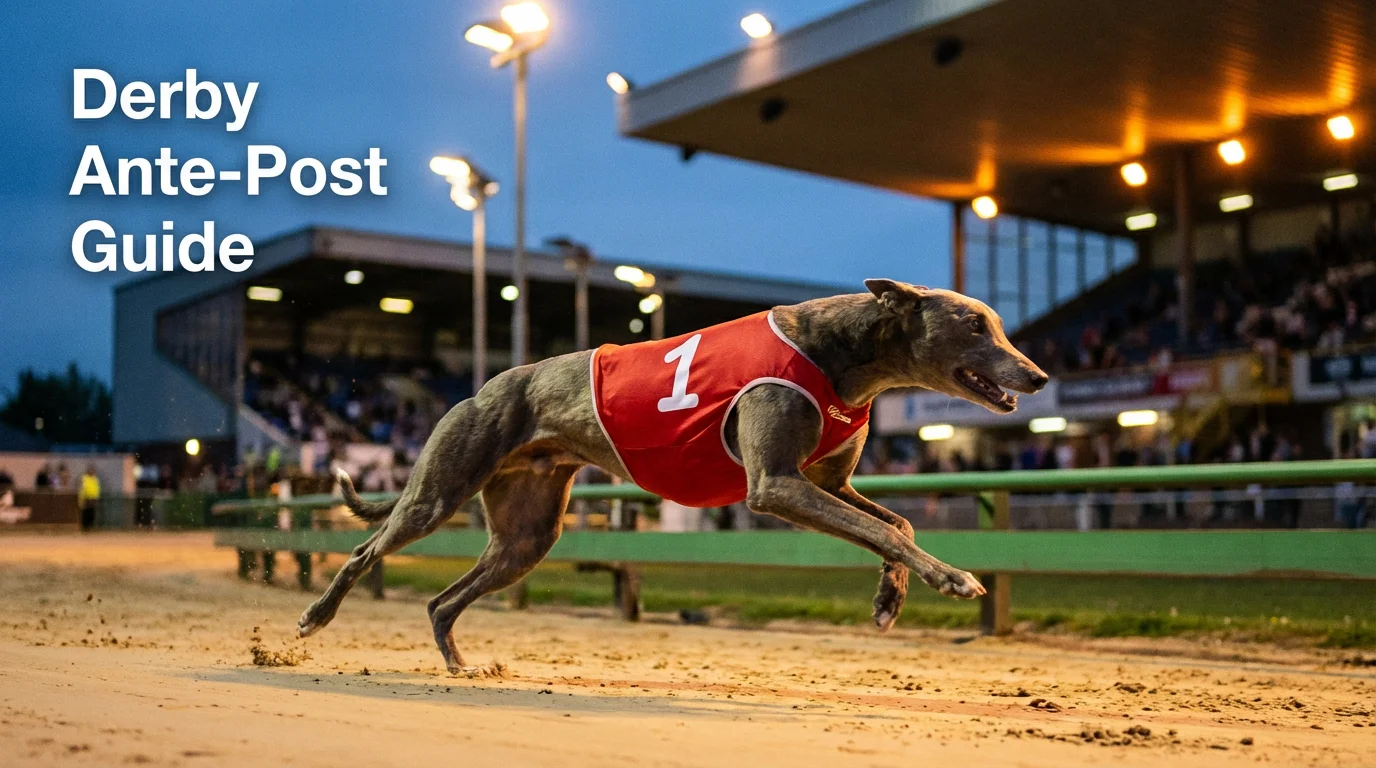
The English Greyhound Derby is the one ante-post market where even casual punters start paying attention six weeks before the final. There is a reason for that. No other greyhound event compresses so much uncertainty into a single futures market: roughly 192 entries, whittled down through a knockout format, until six dogs line up at Towcester for a race worth north of 175,000 pounds. Back a dog in May, and by the time the final runs in late June, your selection will have survived — or not — four elimination rounds. That is the deal you are making when you place an ante-post bet on the Derby. Bigger odds in exchange for the very real possibility that your dog never reaches the final at all.
This is what separates Derby ante-post from almost any other greyhound futures market. In a typical Category One event, maybe forty or fifty dogs are entered, and the attrition rate is manageable. In the Derby, the field is enormous, the rounds are relentless, and every heat carries its own set of risks: trap draws that don’t suit your dog, collisions at the first bend, injuries in warm-up gallops that never make the trade press until it’s too late. The ante-post market prices all of this in — which is why you’ll see 33/1 on a genuine contender that would be 5/1 on the night of the final.
But here’s the thing: the Derby is also where the biggest ante-post payouts in greyhound racing consistently land. The knockout structure warps the market. Bookmakers set their initial prices with limited information — trial times, grading records, kennel reputation — and the public tends to lump money on familiar names. If you’re willing to do the forensic work, the early-stage Derby market regularly offers prices that don’t reflect a dog’s true chance of making the final six. That gap between perceived probability and actual probability is where the value lives. This guide is about finding it — the format, the form, the trainers, and the timing that turn a speculative punt into a structured ante-post position.
English Greyhound Derby Format & Ante-Post Timeline
Understand the plumbing before you bet on the water pressure. The English Greyhound Derby is a knockout tournament run at Towcester over 500 metres, and its structure dictates everything about the ante-post market — from initial pricing to the rate at which your selection’s chances evaporate or crystallise.
The tournament typically begins in early June with first-round heats. Around 192 entries are split across 32 heats of six dogs each. The top two finishers in each heat advance, along with a selection of fastest losers, bringing the second-round field down to roughly 48 dogs. From there, the same process repeats: second-round heats produce quarter-finalists, quarter-finals produce semi-finalists, and the semi-finals deliver the six dogs that contest the final, usually held in late June or early July. The whole thing runs across three to four weeks, which means your ante-post bet — placed potentially six weeks before the first heat — has to survive multiple rounds of elimination, each carrying its own trap draw, its own pace dynamics, and its own injury risk.
Ante-post markets for the Derby typically open four to six weeks before the heats begin, sometimes earlier if a particular dog generates buzz through open-race performances or high-profile trials. At the point of market opening, the bookmaker is pricing a field of close to 200 dogs, most of which have never run at Towcester, many of which haven’t trialled over the course, and some of which may not even be confirmed entries. The initial prices reflect this fog of uncertainty, and that is precisely why they are worth paying attention to.
How the Knockout Format Shapes Ante-Post Odds
The knockout format introduces a concept you won’t find in standard race-day betting: survivorship value. Every round your dog survives, its ante-post odds — had you waited to bet — would have shortened. A dog priced at 33/1 when markets open might be 14/1 after clearing the first round and 6/1 by the semi-final stage. That compression is the ante-post bettor’s reward for taking early risk.
But survivorship works both ways. A dog that draws trap six in a heat loaded with early-pace runners can be eliminated in sixty seconds, regardless of its talent. The Derby format does not care about your form analysis — it cares about what happens on the track in that specific race, against that specific set of rivals, from that specific trap. This is why the early-stage knockout rounds are the highest-risk zone for ante-post bets and, paradoxically, the period when the most value is available. The market cannot accurately price the interaction of trap draw, pace, and field composition across four consecutive rounds. It does its best — and its best is often wrong enough to exploit.
One practical point: watch the confirmed entry lists. Some dogs are entered speculatively by trainers who withdraw before the heats if form or fitness isn’t right. A confirmed entries list that shows your 33/1 selection as a definite runner is a small but meaningful signal. Conversely, if your selection is from a kennel that routinely enters five or six dogs in the Derby, expect one or two to be pulled. The trainer is running their own form of portfolio management, and so should you.
How to Analyse Greyhound Derby Ante-Post Form
Form analysis for Derby ante-post is forensic — you’re not picking today’s winner, you’re pricing six weeks of survival. That distinction matters because the variables that predict a single 500-metre race and the variables that predict a dog lasting four consecutive knockout rounds are not the same thing. A dog with blistering early pace and one preferred trap is a strong bet in a one-off race but a poor bet in a tournament where the draw changes every round.
Start with what you can measure. The core data points for Derby ante-post form are: recent times over 480m to 500m at any track, sectional times (first-bend split versus finishing split), grading history over the previous three to four months, and course form at Towcester specifically. If a dog has trialled at Towcester, that trial time is more informative than six wins at Romford. Towcester runs wider than most UK tracks, its bends are more sweeping, and the 500-metre trip plays differently than a tight circuit like Hove. Dogs that rely on inside rail running can struggle there; dogs with a wide-running style tend to overperform relative to their graded form elsewhere.
Age matters more than most punters acknowledge. Greyhounds peak between roughly 24 and 36 months of age. A dog entering the Derby at two years old is likely still improving; a dog at three and a half may be holding form but is unlikely to be faster next month than it is today. For ante-post purposes, the younger dog carries more upside variance — its ceiling is unknown, which is both the risk and the opportunity. Check the whelp date. If your selection turned two in January, it’s in the sweet spot for a June Derby.
Then there’s the less quantifiable stuff: fitness trajectory. Is the dog improving race by race, or has it plateaued? Look at the last five runs. A sequence of runs showing progressively faster sectional times — even if finishing positions haven’t improved — suggests a dog that’s moving in the right direction. Conversely, a dog that won its last three races but posted identical times in all three might simply be racing in weak graded company.
Speed Ratings and Sectional Times for Derby Dogs
Speed ratings are the closest thing greyhound racing has to a universal currency. Services like Timeform Greyhounds and the Racing Post assign numerical ratings that adjust raw times for track, grade, and going conditions. For Derby ante-post, you want dogs rated in the mid-to-high range of open-race class — typically a Timeform rating above the mid-nineties for a dog with genuine final ambitions.
Sectional times add a layer of detail that aggregate ratings miss. The Derby is run over 500 metres, and the first-bend sectional — the time from trap to the first bend — tells you how a dog handles the critical opening phase where most trouble occurs. A dog that consistently reaches the first bend in the leading group, without being a kamikaze early-pace runner that fades over the final 150 metres, has a structural advantage in a knockout format. It avoids traffic, stays out of trouble, and conserves enough energy to finish the race. If you can find a dog that combines a quick first-bend time (sub-4.50 seconds at Towcester) with a strong finishing sectional, you’ve identified a dog that the format suits. These dogs tend to be underpriced in ante-post markets because their win rate in open races may not look spectacular — they don’t blow fields away — but they consistently make the frame, which is what the knockout format rewards.
Trainer Records at the English Greyhound Derby
The Greyhound Derby is dominated by a small number of kennels, and this concentration is not accidental. Training a dog for a three-week knockout tournament requires specific preparation — managing the dog’s energy across rounds, adjusting for different trap draws, and making tactical decisions about when to push and when to protect. Not every trainer does this well.
Charlie Lister OBE is the most decorated trainer in Derby history, with seven victories and a record that spans decades. His kennel’s strength is depth: he enters multiple dogs, prepares them specifically for the Towcester track, and consistently gets more dogs through to the later stages than any other operation in Britain. For ante-post purposes, a Lister entry at a reasonable price is always worth a look — not because every dog wins, but because the kennel’s tournament management reduces the variance that destroys most ante-post bets.
From the Irish side, trainers like Graham Holland and Liam Dowling have made the English Derby a regular raiding target. Holland won back-to-back English Derbies in 2022 and 2023 and has had multiple finalists; Dowling’s kennel consistently produces dogs with the speed and temperament to handle cross-channel travel and an unfamiliar track. Irish-trained dogs in the Derby ante-post market often carry slightly longer odds than their form justifies, partly because UK punters are less familiar with Irish grading and partly because the market anchors on dogs that have already run at Towcester. That unfamiliarity can be an edge.
The practical takeaway: when assessing an individual dog’s ante-post price, weight the trainer’s Derby record heavily. A moderate dog from a proven Derby kennel is, on a tournament-survival basis, often a better ante-post proposition than a faster dog from a trainer who has never navigated a three-week knockout. The trainer is managing the campaign; you are betting on the campaign, not just the dog.
Greyhound Derby Ante-Post Odds: Where to Find Value
The market at 33/1 isn’t wrong — but it might be slow. Ante-post greyhound odds reflect what the bookmaker knows at the moment the market is published, and in the weeks before Derby heats, what any bookmaker knows is surprisingly limited. Trial times are sometimes publicly available, sometimes not. Entries aren’t finalised until close to the off. Form from graded races at other tracks translates imperfectly to Towcester’s specific layout. This information vacuum is what makes Derby ante-post markets inefficient, and inefficiency is where value lives.
The typical price distribution at market opening looks something like this: one or two market leaders at 8/1 to 12/1, a cluster of fancied dogs between 16/1 and 25/1, and a long tail of entries from 33/1 out to 100/1 and beyond. The favourites at this stage are usually dogs that have won high-profile open races in the preceding months — the names that appear in Racing Post headlines. They’re favoured because they’re visible, not necessarily because they’re the best-equipped for a knockout tournament at Towcester. That distinction is crucial. Visibility bias in thin markets creates a predictable pattern: the top of the market is slightly overbet, and the 20/1 to 40/1 range is where the genuine ante-post value tends to concentrate.
How do you identify it? Start by converting odds to implied probability. A dog at 25/1 carries an implied probability of roughly 3.8 percent. Ask yourself: does this dog have a better than one-in-twenty-six chance of winning the final? Factor in the kennel’s track record, the dog’s form trajectory, its age, its adaptability across traps, and its speed ratings relative to the rest of the field. If your assessment puts the dog’s true probability materially higher than the implied price — say, you think it’s closer to a 6 or 7 percent chance — the bet has positive expected value regardless of whether the dog actually wins.
Shopping across bookmakers is non-negotiable. Ante-post greyhound prices vary dramatically between firms because these are manually priced markets with low volume. It is entirely normal to find the same dog at 20/1 with one bookmaker and 33/1 with another. Oddschecker is the standard comparison tool for UK greyhound ante-post. Betfair’s exchange markets for the Derby are thin but worth monitoring — when a dog’s exchange price diverges significantly from the best bookmaker price, it often signals where the sharp money is landing. The five minutes it takes to check three or four prices before placing can be the difference between a bet at value and a bet at a loss.
One historical note worth holding in your head: outright Derby favourites have a poor conversion rate. Over the last twenty years, the pre-tournament market favourite has won the final fewer times than a random-probability model would predict. The market consistently overestimates the favourite’s ability to survive the full tournament. This doesn’t mean you should never back the favourite — it means the favourite’s price almost always overstates their edge, and the smart ante-post money flows slightly further down the card.
Ante-Post Pitfalls Specific to the Greyhound Derby
Non-runners in Derby ante-post aren’t edge cases — they’re the norm. Of the roughly 192 dogs entered, a significant number will not complete the tournament, and a meaningful percentage will not start at all. Injuries during heats, illness, loss of form, trainer withdrawals, and failed trials account for a steady stream of eliminations that have nothing to do with on-track performance. If you’re placing ante-post bets on the Derby, you need to accept that a substantial proportion of your bets will lose not because you picked the wrong dog, but because the dog never got the chance to prove you right or wrong.
The default ante-post rule is unforgiving: if your selection doesn’t run, you lose your stake. Full stop. There are no refunds, no Rule 4 deductions, no consolation returns. Some bookmakers offer “no runner no bet” promotions on the Derby, but these are typically limited to specific selections or specific stages of the tournament, and the conditions vary. Read the terms before you place the bet, not after your dog is scratched from the quarter-finals. If NRNB isn’t explicitly stated on the betslip, assume your stake is at risk from the moment you click confirm.
The re-draw between rounds is another pitfall that catches inexperienced ante-post punters off guard. Your dog may have a clear preference for trap one — and it might draw trap one in the first round. But in the second round, it could draw trap six. In the semi-final, trap three. The knockout format reshuffles the deck at every stage, and a dog’s trap draw in each round can dramatically affect its chances of survival. This is why trap versatility is such a critical form factor for Derby ante-post: a dog that can only win from the inside box is a poor tournament prospect, no matter how fast it is when the draw falls in its favour.
Kennel bias is a subtler trap. Punters often back the most famous dog from a leading kennel, ignoring the kennel’s second or third string that might be better suited to the specific conditions of the Derby. A trainer entering four dogs is not backing all four equally — they’ll have a private view on which one is the campaign horse and which ones are in the field to gain experience or protect the draw. You won’t always know which is which, but studying the kennel’s trial allocations and the sequence of race entries in the weeks before the Derby can offer clues. If one dog has been given two Towcester trials and another from the same kennel hasn’t been trialled at all, that tells you something about the trainer’s priorities.
Finally, watch out for the hype cycle. Every year, a dog emerges from the open-race circuit in April or May with a spectacular run — a track record, a demolition job, a time that lights up social media. The ante-post market reacts immediately: the dog’s price halves, money piles in, and by the time the heats start, it’s the clear favourite. These dogs often perform well. But the ante-post value was in the price before the hype, not after. If you’re chasing a dog whose price has already collapsed from 25/1 to 8/1 on the back of one race, you’re buying the narrative, not the probability. The market has already priced in the performance. Your edge is gone.
The Winner’s Kennel — Reading Ante-Post Signs
The best Derby ante-post bet often isn’t a dog — it’s a trainer. This isn’t a dismissal of individual form analysis. It’s an acknowledgment that in a knockout tournament lasting three weeks, the campaign matters more than any single performance. The dog that wins the Derby final isn’t always the fastest dog in the field. It’s the dog that was prepared for a specific track, managed through multiple rounds, protected from unnecessary strain, and positioned by a trainer who has done this before and knows what the knockout format demands.
Think of it this way: you are not betting on a 30-second race. You are betting on a three-week project managed by a kennel with finite resources, a track record of strategic decisions, and — this is the part most punters miss — a view on the tournament that you will never fully see. The trainer knows which dog is the stable star. The trainer knows which dog handles stress, which one recovers between rounds, which one will eat on travel day and which one won’t. None of that is in the form book. But it shows up in the results, year after year, when the same handful of kennels account for a disproportionate share of finalists.
If you take one thing from this guide, let it be this: price the campaign, not the moment. The ante-post market gives you weeks to watch, assess, and decide. Use that time. Study the entries, not the headlines. Look at the kennel, not just the dog. And when you find a price that underestimates a proven operation’s ability to navigate the knockout gauntlet, act on it — because that is the closest thing to a structural edge that the English Greyhound Derby ante-post market offers.