
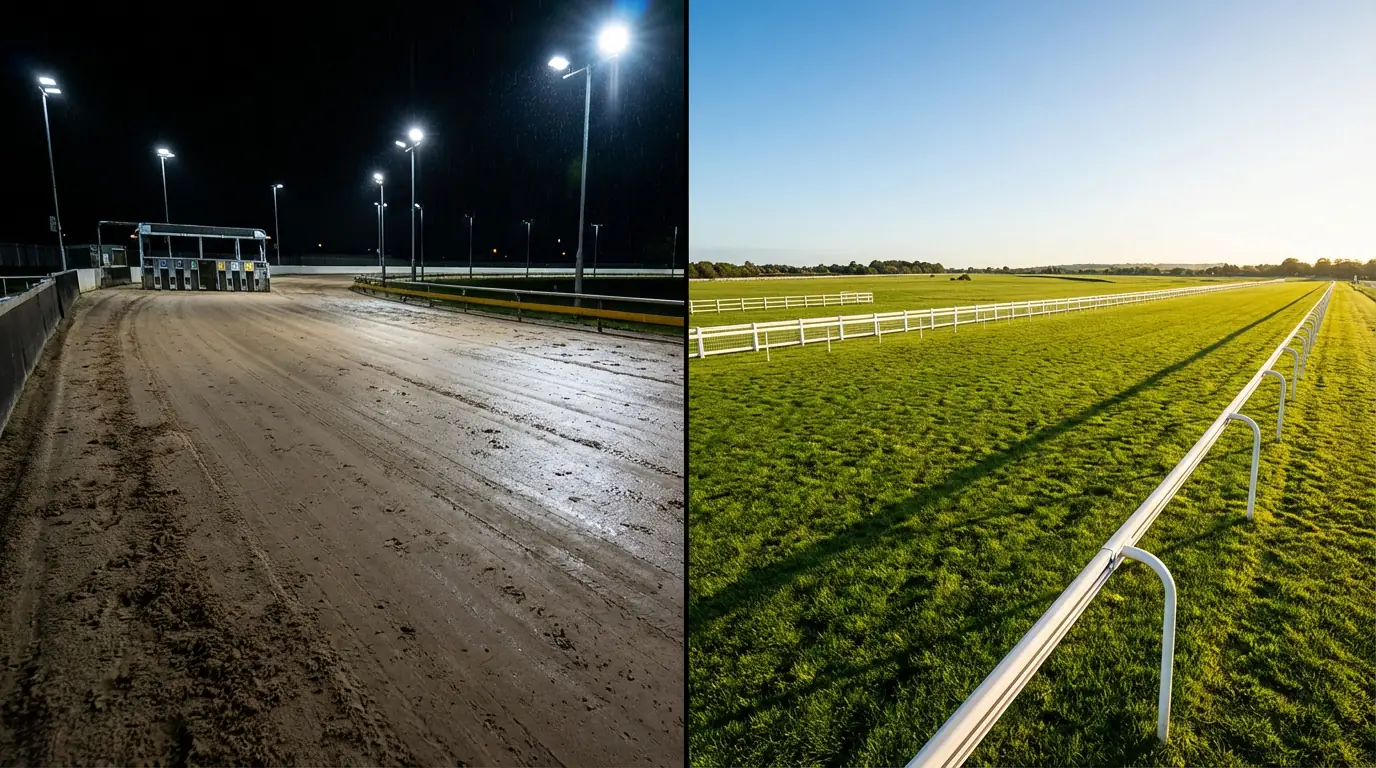
Ante-post betting exists in both greyhound racing and horse racing, and the surface mechanics are identical: you place a bet on a future event, accept the risk that your selection might not run, and lock in a price that reflects the uncertainty of betting early. But beneath that shared framework, the two markets are so different in depth, liquidity, information flow, and risk profile that strategies built for one don’t transfer cleanly to the other.
Horse racing ante-post is a mature, heavily traded market. The Cheltenham Festival, the Epsom Derby, Royal Ascot — these events generate ante-post books that are months deep, priced by dozens of bookmakers, and bet into by a vast pool of professional and recreational punters. Greyhound ante-post is a niche within a niche: fewer events, fewer bookmakers, less money, and a much thinner information ecosystem. Understanding these differences is essential for punters who bet ante-post across both sports, and for greyhound specialists who want to understand what makes their market distinct.
This article compares the two markets across the dimensions that matter most to futures bettors: liquidity, non-runner risk, odds quality, and information asymmetry.
Market Depth and Liquidity Compared
The most striking difference between greyhound and horse racing ante-post markets is scale. Horse racing ante-post markets on major events are among the most liquid futures betting markets in sport. The ante-post book on the Cheltenham Gold Cup might be priced by 15 to 20 bookmakers simultaneously, with each firm offering odds on 30 to 50 runners. Exchange liquidity on Betfair for major horse racing ante-post events can run into six figures per selection, meaning you can place significant bets without meaningfully moving the market.
Greyhound ante-post markets operate at a fraction of that scale. The English Derby ante-post book might be priced by four to six bookmakers, with each offering odds on 20 to 40 dogs. Exchange liquidity is minimal — a few hundred pounds at best on the most popular selections, and nothing at all on the longer-priced entries. A single £200 bet on a 25/1 shot in a greyhound ante-post market can visibly move the price. The same bet in a horse racing ante-post market on a 25/1 Cheltenham selection would be absorbed without trace.
This difference in liquidity has practical consequences for bettors. In horse racing, you can shop for the best price across a wide range of bookmakers and be confident of getting your bet accepted at a meaningful stake. In greyhound racing, the choice of bookmakers is smaller, the odds spread between firms can be wider, and stake acceptance is less guaranteed — particularly on shorter-priced selections where the bookmaker’s potential liability is larger relative to the total market volume.
The thinner liquidity in greyhound ante-post markets also means that prices are less efficient. In horse racing, the sheer volume of money and opinion flowing into ante-post markets pushes prices toward their “true” level relatively quickly. New information — trial results, stable tours, trainer comments — is absorbed rapidly because thousands of participants are watching and acting. In greyhound racing, information absorption is slower because fewer people are watching, fewer bookmakers are adjusting, and the channels through which information flows are narrower. Prices in greyhound ante-post markets may take days to adjust to new information that would be priced into a horse racing market within hours.
For bettors, this slower information absorption is the primary source of edge in greyhound ante-post markets. If you’re among the first to act on a meaningful trial result or form update, you can secure a price that hasn’t yet adjusted — and may not adjust for days. That window of opportunity is dramatically shorter in horse racing, where the market is too deep and too closely watched for inefficiencies to persist.
Non-Runner Risk: Dogs vs Horses
Non-runner risk is the defining feature of ante-post betting in any sport, and the risk profile differs substantially between greyhounds and horses.
In horse racing, ante-post non-runner rates vary by event type and timing. For flat racing classics — the Epsom Derby, the 2,000 Guineas — the non-runner rate from early ante-post markets is significant, because many horses are entered speculatively and then withdrawn as the race approaches. For National Hunt festivals like Cheltenham, non-runner rates can exceed 30% from the early ante-post book, because the demands of jumps racing make injuries and setbacks common. However, horse racing benefits from extensive pre-race information: daily training reports, stable visits by journalists, official declarations process, and a culture of public commentary from trainers that gives punters advance warning of potential withdrawals.
In greyhound racing, the non-runner risk profile is different. Greyhounds are more physically resilient than thoroughbred racehorses over short distances — the injury rate per race is lower, and the recovery time between races is shorter. However, greyhound events are knockout tournaments, which means a single poor performance can function like a non-runner for ante-post purposes: your dog is eliminated in the heats, your bet is a loser, and the outcome is settled weeks before the final. The non-runner in the traditional sense — a dog withdrawn entirely before the event — occurs, but the more common ante-post failure mode is heat-round elimination.
The information available to assess non-runner risk also differs. Horse racing has a robust public information infrastructure: trainers give interviews, horses are photographed in training, veterinary updates are sometimes published, and the declarations system gives formal notice of participation. Greyhound racing’s information flow is sparser. Trainers are less publicly visible, training updates are shared informally (social media, specialist forums) rather than through official channels, and the first indication of a fitness problem may be a poor trial or an unexplained absence from a regular racing schedule. Ante-post greyhound bettors need to be more proactive in seeking information, because the sport doesn’t deliver it as systematically as horse racing does.
NRNB offers are more common in horse racing ante-post than in greyhound ante-post, reflecting the larger commercial investment bookmakers make in horse racing markets. Major Cheltenham ante-post markets frequently carry NRNB promotions. Equivalent promotions on greyhound events are rarer and more selective.
Odds, Timing and Information Asymmetry
Ante-post odds in horse racing and greyhound racing are set through fundamentally similar processes — a bookmaker’s trading team estimates probabilities and offers prices — but the inputs to that process differ in quality and volume.
Horse racing odds are informed by a vast ecosystem of public information: official ratings, race replays, pedigree analysis, going preferences, jockey bookings, trainer statistics, and an army of professional tipsters and form analysts who dissect every data point. The price you’re offered on a horse in an ante-post market is the product of intense analytical competition. The bookmaker’s price is informed by the same public data you have access to, refined by the opinions of thousands of other bettors who have bet into the market before you. Finding value requires either better analysis than the crowd or earlier access to information.
Greyhound racing odds are informed by a smaller, less standardised data set: race times, finishing positions, grade, and trainer identity. There is no equivalent of the official handicapper’s rating. Pedigree analysis is less developed. Jockey bookings (the greyhound equivalent would be trap draws, which aren’t known in advance for ante-post purposes) aren’t a factor. The bookmaker’s trading team sets prices using available data, but the data is thinner, the analytical competition is weaker, and the prices are correspondingly less refined.
This creates a different kind of information asymmetry in each sport. In horse racing, the asymmetry is narrow — most relevant information is public, and the value lies in interpreting it better than the market rather than knowing something the market doesn’t. In greyhound racing, the asymmetry can be wider — information like trial results, kennel whispers, and track-specific form patterns may be available to attentive punters before it’s reflected in the market price. The greyhound ante-post bettor who monitors specialist sources can genuinely know something the market doesn’t, rather than merely interpreting the same data more skillfully.
Timing dynamics differ too. Horse racing ante-post markets for major events like Cheltenham open months in advance — sometimes a year — giving punters an extended window to research, monitor, and act. Greyhound ante-post markets typically open four to six weeks before an event, with a shorter window that demands faster decision-making. The compressed timeline in greyhound racing means that the earliest prices carry the most potential value but also the most uncertainty, and the window for the market to correct mispricings before the event starts is shorter.
Two Sports, One Principle
The differences between greyhound and horse racing ante-post markets are significant — in scale, liquidity, information infrastructure, and risk profile. But the underlying principle of ante-post betting is the same in both: you’re accepting additional risk in exchange for better odds, and the profit comes from identifying situations where the additional risk is more than compensated by the price.
What distinguishes greyhound ante-post from horse racing ante-post is not the principle but the practical environment. Greyhound markets are thinner, less scrutinised, and slower to absorb information — all of which makes them less efficient. For the recreational punter, that means more volatility and more uncertainty. For the informed, disciplined bettor, it means a market where the edge is larger and more persistent than anything the deep, liquid, heavily analysed horse racing ante-post market can offer. The opportunities exist in both sports. They’re just easier to find in the one fewer people are looking at.