
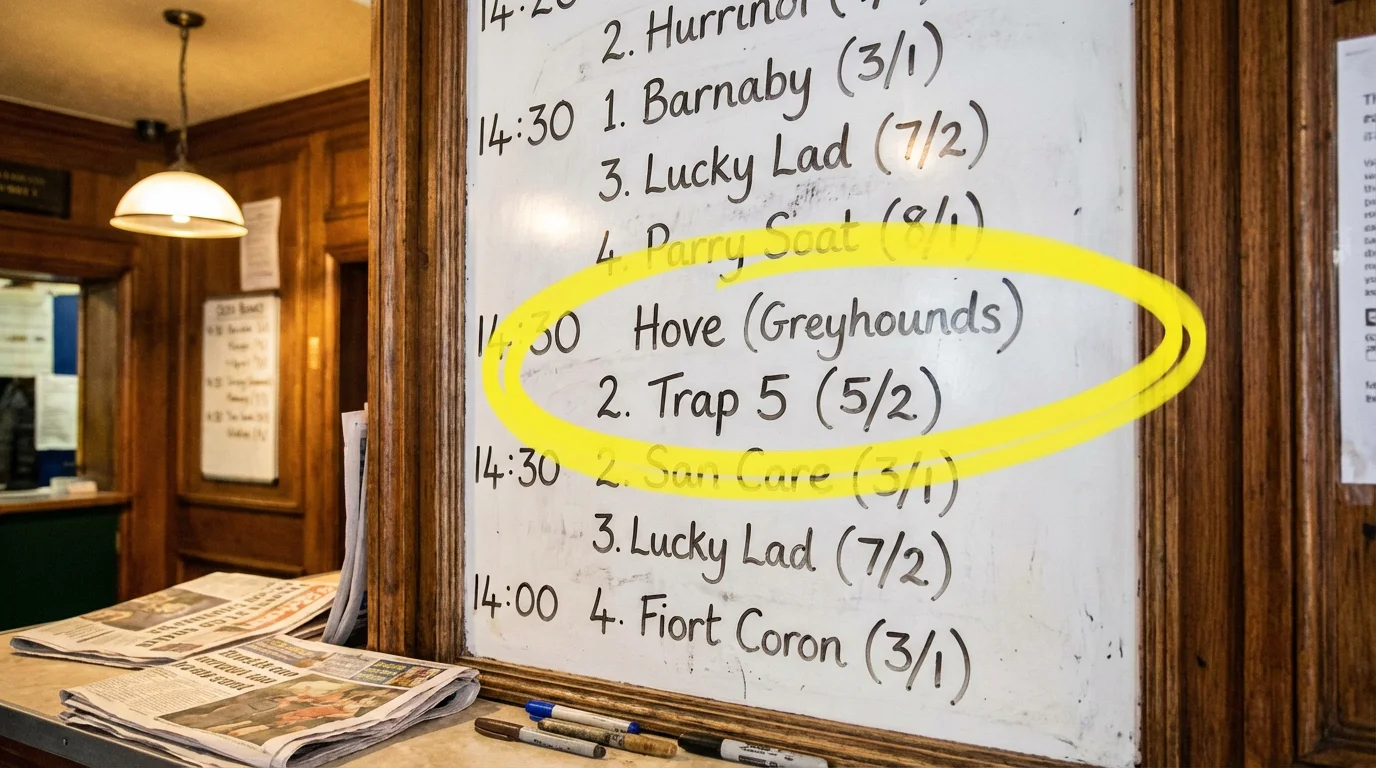
Best Odds Guaranteed is one of those promotions that sounds too good to question. You take a price on a greyhound, and if the starting price on race day is higher than the odds you accepted, the bookmaker pays you at the better number. It’s a safety net that removes the nagging feeling of having backed a dog at 5/1 only to watch it go off at 8/1. For day-of-race greyhound betting, BOG is common enough that many punters take it for granted.
The question is whether that guarantee extends to ante-post bets. And the short answer, for the vast majority of bookmakers and the vast majority of greyhound futures markets, is no. Best Odds Guaranteed almost never applies to ante-post greyhound wagers, and understanding why requires a closer look at what BOG actually is, how bookmakers structure the promotion, and why the mechanics of ante-post pricing make it commercially unviable as a blanket offer.
This matters because a surprising number of bettors place ante-post greyhound bets assuming they’re covered by the same BOG terms they enjoy on regular race-day wagers. The discovery that they’re not — usually after settlement — is a frustrating but avoidable lesson. The terms are clear, but they’re buried in the kind of fine print that most people scroll past.
What follows is a practical walkthrough of BOG as it applies, or more accurately doesn’t apply, to ante-post greyhound markets. We’ll cover the general policy position, break down the approach of major UK bookmakers, and explain the commercial logic that makes ante-post BOG a near-impossibility. If you’re placing futures bets on greyhounds, the price you take is almost certainly the price you’ll be paid at. That’s not a complaint — it’s the reality of the product, and it shapes how you should think about every ante-post selection you make.
Does BOG Apply to Ante-Post Greyhound Bets?
Best Odds Guaranteed, in its standard form, applies to bets placed at fixed odds before the start of a race where a Starting Price is declared. If the SP turns out to be higher than the price you took, the bookmaker pays out at the SP instead. It’s a promotion designed for day-of-race betting — the scenario where you accept a price in the morning or early afternoon and the market moves against you by the time the race goes off.
Ante-post bets exist in a different universe. When you place an ante-post wager on a greyhound competition — say, backing a dog at 14/1 for the English Greyhound Derby six weeks before the final — there is no single Starting Price that corresponds to your bet in the way BOG requires. The competition hasn’t happened yet. The heats haven’t been run. The dog might not even make the final. The concept of a “starting price” as a reference point for BOG doesn’t map cleanly onto a bet placed weeks before the event concludes.
Even in cases where the ante-post selection does reach the final and a Starting Price is declared for that final race, the BOG promotion typically excludes ante-post wagers by definition. The standard terms and conditions for BOG at most UK bookmakers include language specifying that the offer applies to bets placed on the day of the race, or at earliest the day before, and explicitly excludes bets placed under ante-post terms. The wording varies, but the effect is consistent: ante-post means no BOG.
There’s a logical reason for this beyond the technicality. The whole point of ante-post betting is that you’re trading certainty for price. The odds are bigger because you’re accepting risks that day-of-race bettors don’t face — non-runner forfeit, competition withdrawal, injury before the event. If the bookmaker also guaranteed you the best available price at the time of the race, the risk-reward equation would collapse. You’d be getting the upside of early pricing with the downside protection of a race-day guarantee. No bookmaker would offer that without pricing the ante-post market significantly tighter, which would defeat the purpose of offering ante-post odds in the first place.
Some punters wonder whether the BOG exclusion applies to all ante-post markets or only to specific events. In practice, it’s all of them. Whether you’re betting on the Derby, the Irish Derby, the St Leger, or any other greyhound competition priced on an ante-post basis, the BOG promotion will not apply. If a bookmaker’s greyhound section shows a BOG badge or banner, it refers to their day-of-race greyhound markets, not their futures markets. The two are separate products with separate terms.
The only scenario in which something resembling BOG might apply is if a bookmaker runs a specific, time-limited promotion explicitly extending best odds to ante-post greyhound selections. These promotions are rare to the point of being essentially theoretical. In over a decade of major UK bookmaker operations, no operator has made ante-post BOG a standard feature of their greyhound product. If it ever appears, it will be promotional, temporary, and almost certainly subject to conditions that limit the bookmaker’s exposure — maximum payout caps, specific events only, or restrictions on qualifying stakes.
Bookmaker-by-Bookmaker BOG Policies
While the general rule is clear — BOG doesn’t apply to ante-post greyhound bets — the specific terms vary enough between bookmakers that it’s worth checking what each operator actually says. Assumptions can be expensive, and the wording in terms and conditions occasionally contains nuances that matter.
Bet365 offers Best Odds Guaranteed on UK and Irish greyhound racing as part of its standard product. The promotion applies to win bets placed at fixed odds on races where a Starting Price is declared. Ante-post bets are excluded. The terms are explicit: wagers placed on ante-post markets do not qualify for BOG, and the price you accept at the time of placement is the price at which your bet will be settled. Bet365’s greyhound ante-post section and their day-of-race section operate under separate terms, even though they appear on the same platform.
William Hill’s approach is similar. Their BOG offer on greyhounds covers race-day selections, and ante-post bets fall outside the scope of the promotion. William Hill’s terms specify that only bets placed on the day of the race are eligible for best odds, with the additional caveat that certain promotional restrictions may apply even to qualifying race-day bets. For ante-post purposes, the message is straightforward: fixed odds taken at the time of the bet are final.
Paddy Power runs a BOG promotion on greyhound racing that mirrors its horse racing equivalent. As with the others, ante-post selections are excluded. Paddy Power’s terms and conditions page for BOG lists the qualifying bet types, and ante-post wagers are not among them. The promotion applies to win and each-way singles placed at fixed odds before the declared Starting Price.
BoyleSports, which has traditionally offered strong greyhound coverage given its Irish heritage, provides BOG on selected greyhound meetings. Again, the promotion is limited to race-day bets. Ante-post greyhound wagers are explicitly excluded, and the terms follow the industry-standard pattern of specifying that BOG applies only where a Starting Price is formally declared for the relevant race and the bet was placed on the day of that race.
Coral and Ladbrokes, both operating under the same parent company, offer similar BOG terms for greyhound racing. Their promotions cover UK and Irish greyhound meetings where BOG is advertised, and both exclude ante-post markets from the promotion. The terms reference day-of-race pricing specifically, and the exclusion of futures bets is stated clearly in the promotional conditions.
BetVictor rounds out the major operators with a comparable stance. BOG on greyhound racing is available for qualifying race-day bets, and ante-post selections are outside the scope. BetVictor’s terms are consistent with the industry norm.
The uniformity across these bookmakers isn’t coincidental. It reflects a shared commercial logic: BOG is a promotional tool designed to encourage race-day betting volume, and extending it to ante-post markets would create an asymmetric risk profile that no bookmaker’s trading desk would accept willingly. The practical takeaway for the ante-post bettor is that you should treat every price you accept in a futures greyhound market as the final price. There is no backstop. The discipline of price shopping — checking multiple bookmakers before committing — becomes even more important in ante-post markets precisely because the price you take is the one you live with.
Why Most Ante-Post Markets Exclude BOG
The commercial reason behind BOG’s exclusion from ante-post greyhound markets comes down to price movement and time horizon. In a day-of-race scenario, the maximum movement between the price you take and the Starting Price is bounded by hours — typically the morning-to-afternoon window. The range of possible movement is limited, and the bookmaker can model the cost of the BOG promotion with reasonable accuracy. Their exposure is quantifiable.
In ante-post markets, the time horizon stretches to weeks or months. A dog priced at 16/1 six weeks before a Derby final could be 4/1 by the time the final arrives — or it could drift to 33/1. The range of potential price movement is enormous, and guaranteeing the best odds across that entire window would expose the bookmaker to uncapped downside risk. If a well-backed ante-post selection shortens dramatically as the competition progresses, the bookmaker would be on the hook for paying out at odds far above the price that currently reflects the market’s view. The cost of that guarantee, aggregated across all ante-post selections in a competition, would be commercially destructive.
There’s also the information asymmetry issue. Ante-post greyhound markets are thin. A handful of informed bets can move a price significantly. If BOG applied, sharp bettors could take large ante-post positions at inflated early prices with the knowledge that they’d be protected if the price shortened — essentially a free option on favourable price movement. Bookmakers are well aware of this dynamic, and excluding ante-post from BOG is partly a defence against sophisticated exploitation.
Finally, there’s the structural issue of what “starting price” even means in a multi-round tournament. In a single race, the SP is a defined benchmark — the price at the off, determined by the on-course market or an official mechanism. In a tournament with heats, semi-finals, and a final, the starting price of the final race is a narrow snapshot that doesn’t represent the broader market dynamics the ante-post bettor was engaging with. Tying BOG to that single-race SP for a bet placed weeks earlier would create a mismatch between the product the bettor bought and the benchmark used to settle it.
The Guarantee That Isn’t
Best Odds Guaranteed is a powerful marketing phrase. It sounds absolute — a guarantee, no less. But in the context of ante-post greyhound betting, it’s a guarantee that applies to a different product. Your ante-post bet and your BOG-eligible race-day bet might concern the same dog, the same competition, even the same race. They are not the same bet. They operate under different rules, different risk profiles, and different terms. Conflating them is one of the more common misunderstandings in greyhound betting, and it’s one that costs money.
The practical response isn’t resentment — it’s adjustment. If BOG doesn’t apply, then the price you take is the price you own. That makes the moment of selection more important, not less. It makes odds comparison more valuable, not less. And it makes the decision about when to bet — early for bigger prices with more risk, or later for tighter prices with more certainty — the central strategic question of every ante-post wager.
In a way, the absence of BOG is what makes ante-post greyhound betting honest. There’s no safety net. The odds are bigger because the risks are real, and the risks are real because nobody is going to adjust your payout after the fact. You price the bet, you take the bet, and you live with the outcome. That’s a harder product to sell than a guaranteed-best-odds promotion, but it’s a more transparent one.
The guarantee you actually need in ante-post isn’t a better price. It’s better preparation. Know the terms before you bet, shop the odds before you commit, and accept that the number on your betslip is the one that counts. Everything else is marketing.