
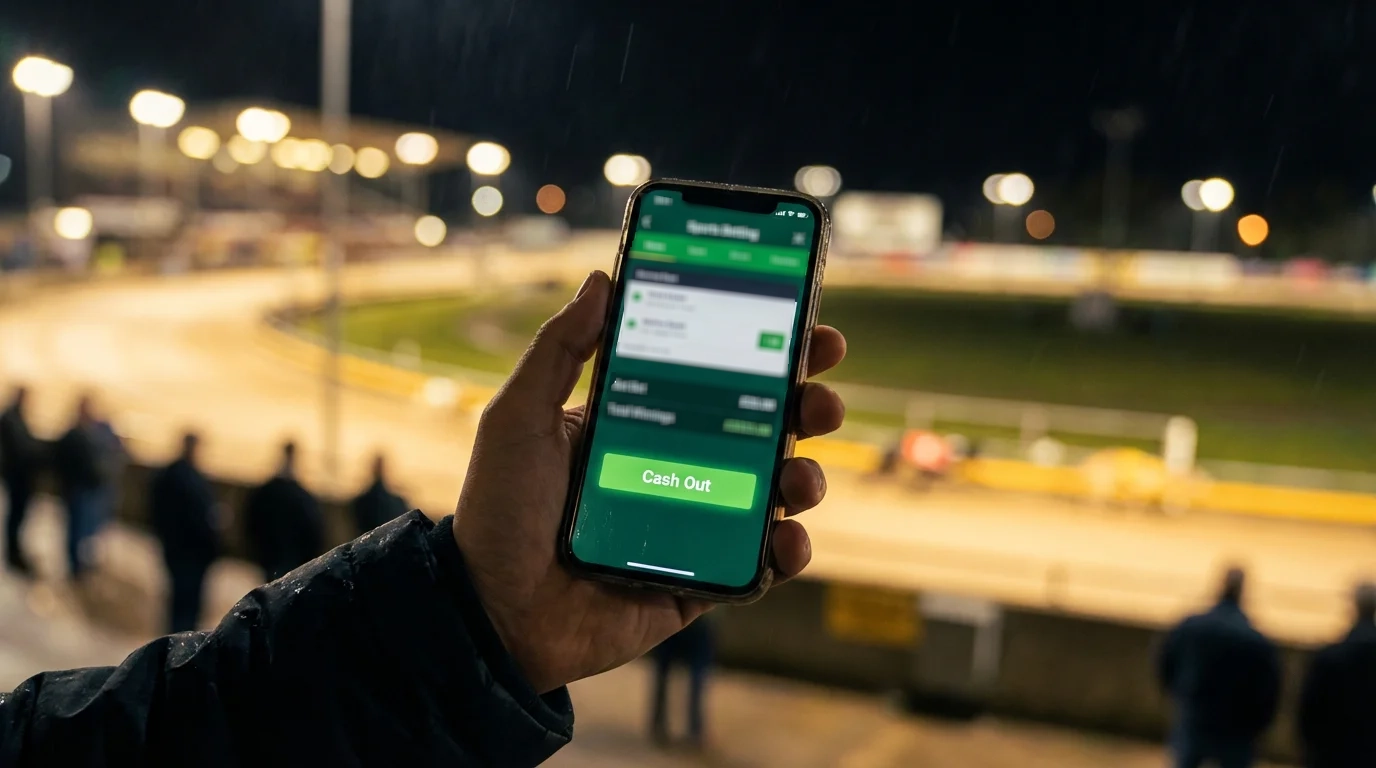
Cash out is the feature that transformed ante-post betting from a binary proposition — win everything or lose everything — into something with a middle ground. Instead of waiting weeks for a final result, you can close your position early, locking in a profit if your dog’s chances have improved since you placed the bet, or cutting your losses if they’ve deteriorated. It’s the closest thing ante-post greyhound betting has to a trading mechanism, and when used correctly, it changes the strategic calculus of futures wagering entirely.
But cash out on ante-post greyhound bets is not universally available, not always fairly priced, and not appropriate in every situation. The feature looks simple — a button, a number, a decision — but the mechanics behind it involve the bookmaker’s margin, the current market price, and the remaining uncertainty in the event. Understanding what’s behind the number is the difference between using cash out as a strategic tool and using it as an emotional crutch that erodes your long-term returns.
This article explains how cash out works on greyhound futures, which bookmakers offer it, and the decision framework for knowing when to take the money and when to let the bet run.
How Cash Out Works on Greyhound Futures
Cash out on an ante-post greyhound bet is an offer from the bookmaker to settle your bet before the event is complete. The offer amount is calculated based on the current implied probability of your selection winning, compared to the implied probability when you placed the bet. If the probability has increased — your dog’s odds have shortened — the cash-out value is higher than your original stake. If the probability has decreased — the odds have lengthened — the cash-out value is lower.
The calculation is conceptually straightforward. Suppose you backed a dog at 20/1 with a £10 stake, giving a potential return of £210 (£200 profit plus £10 stake). Weeks later, the dog has won two heats and its odds have shortened to 5/1. The bookmaker’s cash-out offer might be around £35 to £40 — significantly above your £10 stake but well below the £210 potential payout. The exact figure depends on the bookmaker’s cash-out margin, which is the cut they take for offering the settlement option.
That margin is the hidden cost of cash out. The cash-out offer is not the mathematically fair value of your bet based on current odds — it’s the fair value minus the bookmaker’s margin, which typically ranges from 5% to 15% on ante-post markets. The bookmaker is effectively buying your bet back from you at a discount. This discount is the price of optionality: you’re paying for the certainty of taking money now rather than facing the uncertainty of the remaining rounds.
Cash-out offers on ante-post greyhound bets update dynamically as the competition progresses. After each round of heats, the surviving dogs’ odds shorten (they’re closer to winning) and the eliminated dogs are removed from the market. If your dog survives a heat, your cash-out value increases. If a heavily fancied rival is eliminated, your dog’s odds may shorten even further, pushing the cash-out higher. Conversely, if your dog scrapes through a heat with a poor time or a troubled run, the market may reassess its chances downward, and the cash-out offer could actually decrease even though the dog progressed.
Partial cash out is available from some bookmakers and adds flexibility. Instead of settling the entire bet, you can cash out a portion — say, 50% — while leaving the remainder live. If you placed £10 at 20/1 and the cash-out offer is £40, a 50% partial cash out gives you £20 immediately and leaves a £5 effective stake still running at 20/1 (with a potential remaining return of £105). This lets you secure some profit while keeping exposure to the full upside if the dog goes on to win.
Which Bookmakers Offer Cash Out on Ante-Post?
Cash-out availability on ante-post greyhound bets varies by bookmaker, by event, and by the stage of the competition. No bookmaker guarantees cash out on all ante-post greyhound markets at all times, and the feature can be suspended or removed without notice.
Bet365 is generally the most reliable provider of cash out on ante-post greyhound bets. Their cash-out feature is available on most major event ante-post markets — the English Derby, Irish Derby, and St Leger — and tends to remain active throughout the competition. Bet365 also offers partial cash out on most markets where full cash out is available. The cash-out margins at Bet365 are competitive with the industry standard, though they’re still higher than on day-of-race markets because the ante-post pricing carries more uncertainty.
Paddy Power offers cash out on ante-post greyhound bets, with availability depending on the specific event and market conditions. Cash out on Irish Derby ante-post bets is typically available given Paddy Power’s strong Irish greyhound presence. English Derby and St Leger markets may also carry cash-out functionality, though availability is less consistent than at Bet365. Partial cash out is sometimes available but not guaranteed.
William Hill’s cash-out provision on ante-post greyhound bets is inconsistent. Cash out may be available when the market opens but suspended during the competition, or available on the English Derby but not on smaller events. The unpredictability makes William Hill less suitable for punters who plan to use cash out as an active strategy throughout a tournament.
BoyleSports offers cash out on selected ante-post greyhound markets, particularly those linked to the Irish Derby where the firm has sponsorship ties. Cash-out availability on English events is more limited. The cash-out margins at BoyleSports are broadly in line with the industry, though the smaller volume of ante-post greyhound betting at the firm can sometimes result in less competitive offers.
Betfair’s exchange doesn’t offer cash out in the traditional sense, but exchange users can effectively cash out by laying their selection at the current price. If you backed a dog at 20.0 on the exchange and its price has shortened to 6.0, you can lay it at 6.0 to lock in a profit regardless of the outcome. This is mathematically equivalent to bookmaker cash out but without the bookmaker’s margin — the “cost” is the exchange commission on your winning trade instead. Exchange liquidity on ante-post greyhound markets is thin, so large positions may be difficult to close in a single trade.
When to Cash Out — and When to Hold
The decision to cash out an ante-post greyhound bet is a trade-off between certainty and expected value. Cashing out gives you a guaranteed return at the cost of the remaining upside. Holding gives you the full potential payout at the cost of the remaining risk — including the possibility that your dog loses in the next round and the cash-out value drops to zero.
There are situations where cashing out makes clear strategic sense. If your dog has reached the semi-final or final and the cash-out offer represents a return that meets your objectives for the bet, taking the money eliminates the risk of a losing semi-final or final without an unreasonable sacrifice of expected value. The closer to the final you are, the less remaining upside there is to sacrifice — and the remaining rounds carry the highest individual-round risk because the competition is strongest.
Cash out also makes sense when new information changes your assessment of the dog’s chances. If your selection scraped through a heat with an injury concern, or if a dominant rival has emerged that wasn’t in the field when you placed your bet, the dog’s true probability of winning may have decreased even if the market hasn’t fully adjusted yet. Cashing out at a price that still reflects the earlier, more favourable assessment lets you exit before the market corrects.
Conversely, there are situations where cashing out is a mistake. If the cash-out offer is small relative to the potential return — your dog is still in the heats and the cash-out is barely above your original stake — cashing out captures almost none of the value while eliminating all of the upside. Early-stage cash-out offers on ante-post greyhound bets are typically poor value because the bookmaker’s margin is applied to a high-uncertainty price, resulting in a number that’s much closer to your original stake than to the potential payout.
The biggest cash-out error in ante-post greyhound betting is emotional cashing out: taking the money because you’re nervous, not because the numbers justify it. If your dog is 4/1 for the Derby final and the cash-out offer is £180 on a £10 bet, the expected value of holding the bet to the final (assuming the market price is roughly accurate) is higher than £180. Cashing out because you “don’t want to risk it” is paying a premium for emotional comfort — which is a legitimate personal choice, but it’s not a profitable strategy. Over time, habitual emotional cash-outs transfer value from the punter to the bookmaker.
A useful framework: only cash out when the cash-out offer exceeds your own estimate of the bet’s expected value at the current stage. If you think the bet is worth £150 based on your assessment of the dog’s chances, and the cash-out offer is £180, take it. If the offer is £120, hold. This requires you to maintain an independent assessment throughout the competition rather than relying solely on the bookmaker’s number, which already includes their margin.
Locking In vs Letting It Ride
Cash out on ante-post greyhound bets is a tool, not a strategy. Used selectively — when the numbers justify it, when new information changes your view, or when the competition has reached a stage where the remaining risk outweighs the remaining reward — it adds genuine value to the ante-post experience. Used habitually, as a reflex response to seeing a green number on the screen, it systematically reduces your returns by paying the bookmaker’s cash-out margin on bets that would have been more profitable if left to run.
The punters who use cash out most effectively on ante-post greyhound bets are the ones who made their decision framework before the competition started. They know, in advance, at what stage and at what price they’ll consider cashing out. They’ve set a target return that would represent a satisfactory outcome, and they act when that target is met — without constantly checking the cash-out offer between rounds and agonising over whether to take it. The discipline is in the pre-commitment: decide your exit criteria when your thinking is clear, not when your dog is about to enter the semi-final and your emotions are making the decision for you.