
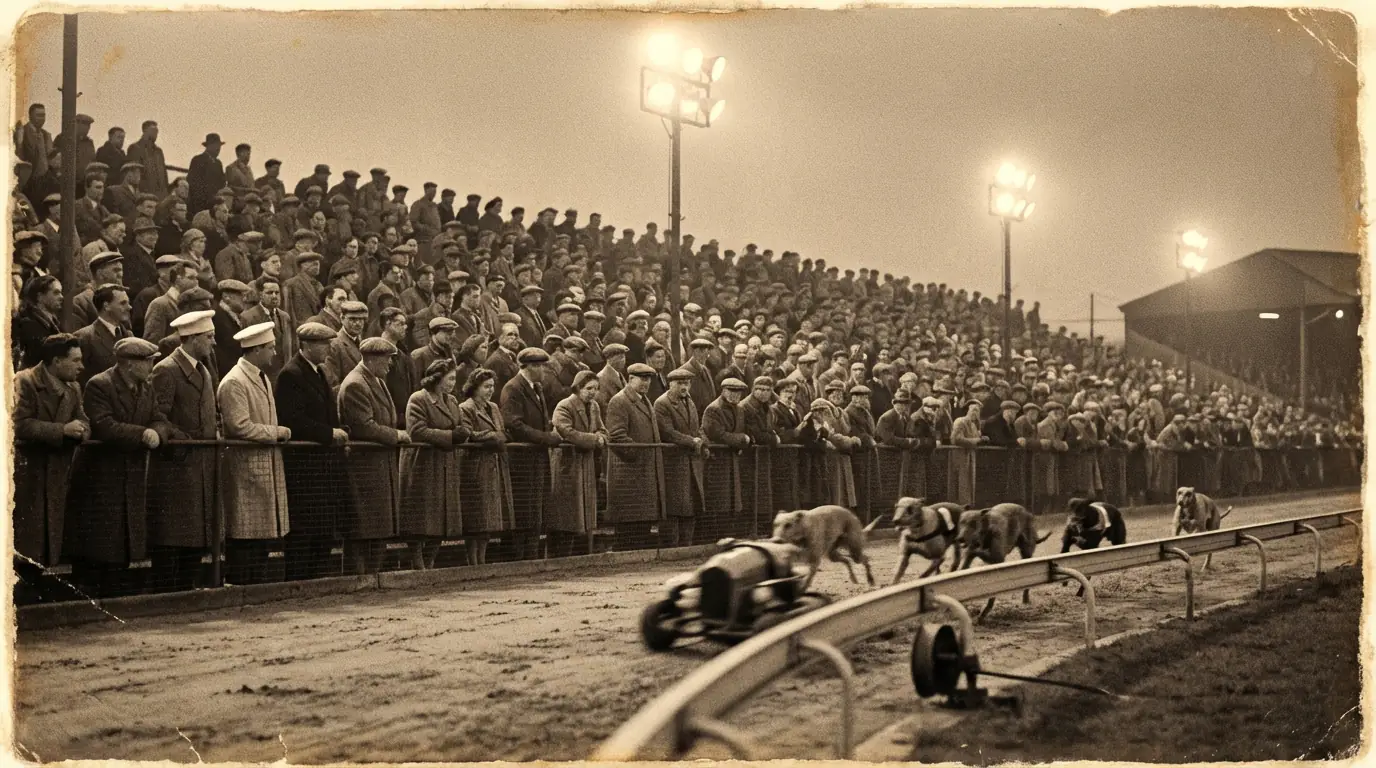
Ante-post greyhound betting didn’t arrive fully formed on a bookmaker’s website. It has a history — one that’s tangled up with the broader story of British greyhound racing, the evolution of legalised gambling, and the slow migration from trackside bookmakers shouting odds in the rain to digital platforms offering prices from anywhere with a mobile signal.
The concept of betting “before the post” predates greyhound racing itself. Horse racing established the ante-post tradition centuries ago, and when organised greyhound racing exploded in popularity in 1920s Britain, the betting infrastructure that grew around it borrowed heavily from its equine predecessor. But greyhound racing was always a different beast — faster, more urban, more working-class, and structured around a calendar of knockout tournaments that created natural opportunities for futures betting.
Tracing the history of ante-post greyhound betting is partly an exercise in tracing the history of the sport itself. The venues changed, the regulations evolved, the money shifted, and the medium through which bets were placed went from hand signals at White City to touchscreen apps on the sofa. Through it all, the fundamental proposition remained the same: back a dog before the competition starts, accept the risk that it might not make the final, and take the bigger price as compensation.
This isn’t a comprehensive history of greyhound racing — that would fill a book and probably has. What follows is a focused look at how ante-post betting on greyhounds developed, the moments that shaped its current form, and why understanding where it came from helps explain the market you’re dealing with today. The rules, the norms, and even the risk profile of modern ante-post greyhound betting all carry traces of decisions made decades ago. Knowing the backstory doesn’t make you a better bettor, but it makes you a more informed one.
Origins of the Betting Post
The term “ante-post” comes from horse racing and literally means “before the post” — a bet placed before the runners line up at the starting post. In horse racing, ante-post betting has existed in some form since at least the 18th century, with major races like the Epsom Derby attracting wagers months in advance. When greyhound racing arrived in Britain in the 1920s, it inherited this tradition almost by default. The bookmakers who served the horse racing public simply extended their operations to the new sport.
Organised greyhound racing in the UK dates to 1926, when the first modern meeting was held at Belle Vue Stadium in Manchester (GBGB). The sport grew with extraordinary speed. Within two years, there were tracks across the country — White City in London, Hall Green in Birmingham, Wimbledon, Harringay, Walthamstow. The appeal was obvious: evening meetings that working-class punters could attend after a shift, fast races that delivered results in under thirty seconds, and a betting experience that was simpler than horse racing’s complex card of runners and form.
Early greyhound betting was overwhelmingly on-course — you placed your bet with a bookmaker standing at the track, often in cash, minutes before the race. There was no real ante-post greyhound market in those early years because the sport’s structure didn’t demand one. Most meetings were standalone events: six or eight races on a Tuesday evening, results settled before closing time. The concept of betting weeks ahead didn’t have an obvious application.
That changed with the creation of prestigious tournament-format competitions. The English Greyhound Derby, first held in 1927 at White City (bet365 News), was the catalyst. Modelled on horse racing’s classic structure, the Derby featured multiple rounds — heats, semi-finals, and a final — spread over several weeks. Suddenly there was a greyhound event where the ultimate winner wouldn’t be determined for weeks after the first races were run. And where there’s a gap between entry and outcome, bookmakers will fill it with prices.
The early ante-post greyhound markets were informal and limited. Track bookmakers might offer prices on the Derby favourite in the weeks leading up to the final, but the market was nothing like the structured odds boards you’d see for the Cheltenham Gold Cup or the Grand National. Greyhound ante-post was a niche within a niche — a small corner of the betting ecosystem reserved for punters who followed the sport closely enough to have an opinion on which dog would emerge from a tournament weeks before the result was known.
Off-course betting, which was illegal in Britain until the Betting and Gaming Act of 1960, also limited the ante-post market’s reach. Before licensed betting shops opened in 1961 (legislation.gov.uk), punters who wanted to bet away from the track had to use credit bookmakers or illegal street bookies. Neither was an ideal channel for futures wagers. The legalisation of off-course betting expanded the customer base for all forms of gambling, and ante-post greyhound markets gradually became a regular feature of the larger bookmakers’ offerings — particularly in the run-up to the Derby and the St Leger.
By the 1970s and 1980s, ante-post greyhound betting was an established if modest part of the UK betting landscape. The big high-street bookmakers — Ladbrokes, William Hill, Coral — would post Derby ante-post prices in their shop windows alongside horse racing futures. The market was still thin, the selections limited, and the prices set by traders working with even less information than today’s operations. But the structure was recognisable: back a dog early, get a bigger price, lose your stake if it doesn’t run.
From Track Betting to Online Futures
The transformation of ante-post greyhound betting from a betting-shop curiosity to an online product mirrors the broader migration of UK gambling to the internet. The late 1990s and early 2000s saw every major bookmaker launch an online platform, and greyhound racing — already a core part of their product — came along for the ride.
The early online betting sites offered greyhound ante-post markets as extensions of their existing trading operations. The prices were still set manually by the same traders who’d been pricing them for the shops, and the range of events covered was similar: the Derby, the Irish Derby, the St Leger, and a handful of other Category One competitions. What changed was accessibility. A punter in Newcastle could now check ante-post greyhound odds at midnight without waiting for the morning paper or visiting a betting shop. The market was always open, even if the range of selections available was still narrow.
The launch of Betfair in 2000 (Betfair) introduced a new dimension. Betting exchanges allowed punters to trade positions on greyhound futures — not just back a dog but lay one, effectively acting as the bookmaker. Exchange ante-post greyhound markets were, and remain, thin. Liquidity is low compared to horse racing futures, and many greyhound ante-post events on Betfair carry little to no matched volume until the competition is well underway. But the exchange model gave ante-post greyhound bettors something they’d never had before: a mechanism to hedge or cash out their positions before the final, without relying on a bookmaker’s cash-out feature.
The mid-2000s through to the 2010s saw the gradual refinement of the online ante-post product. Bookmakers improved their coverage, added more events to the ante-post menu, and developed cash-out features that gave traditional-bookmaker customers some of the flexibility that exchange users already enjoyed. The introduction of live streaming by platforms like Bet365 and William Hill meant that ante-post bettors could watch heats and semi-finals as they happened, tracking the progress of their selections in real time rather than waiting for results to appear in print or on Ceefax.
Mobile betting accelerated the shift further. By the mid-2010s, the majority of online bets in the UK were placed via smartphones, and greyhound ante-post was no exception. The ability to check odds, place a bet, and track results from anywhere removed the last logistical barriers to ante-post participation.
The digitisation also brought transparency. Odds comparison sites like Oddschecker began aggregating greyhound ante-post prices across multiple bookmakers, turning what had once required visits to several betting shops into a thirty-second exercise.
Despite all these changes, the fundamental character of ante-post greyhound betting hasn’t shifted as dramatically as the medium might suggest. The markets are still thin. The events that carry futures odds are still concentrated at the top of the sport. The non-runner risk is still the defining feature. What’s different is the ease of participation and the tools available — not the nature of the bet itself.
Key Moments in Greyhound Ante-Post History
Several moments stand out as inflection points in the development of greyhound ante-post betting, not because they changed the rules overnight but because they shifted the market’s structure in ways that ante-post bettors still feel today.
The closure of White City Stadium in 1984 (Greyhound Racing History) was a symbolic and practical turning point. White City had been the home of the English Greyhound Derby since the inaugural running in 1927, and its closure forced the Derby to relocate — first to Wimbledon, and eventually to its current home at Towcester. Each move changed the track profile, the distance, and the form analysis relevant to ante-post selections. A dog’s suitability to White City’s characteristics became irrelevant overnight, and the ante-post market had to recalibrate.
The Gambling Act of 2005, which came into full effect in 2007 (Gambling Commission), modernised the UK’s regulatory framework and established the Gambling Commission as the single regulatory body. For ante-post greyhound betting, the Act’s most significant effect was in standardising the licensing requirements for online operators, ensuring that the digital ante-post market operated under the same consumer protections as the high-street shops. It also formalised the advertising rules that govern how bookmakers promote ante-post offers.
Wimbledon Stadium’s closure in 2017 (Sky Sports) was another marker. Wimbledon had hosted the Derby from 1985 to 2016 and was one of the last high-profile London greyhound tracks. Its closure reinforced the long-term trend of track closures across the UK — a trend that has reduced the number of major venues capable of hosting Category One competitions and, by extension, the number of events that generate ante-post markets.
The relocation of the English Greyhound Derby to Towcester — and the financial difficulties Towcester itself faced before being secured — illustrated the fragility of the infrastructure that ante-post greyhound betting depends on. Without viable tracks hosting prestigious competitions, there are no futures markets. The sport’s physical footprint directly determines the breadth and depth of the ante-post product available to bettors.
These moments, taken together, tell a story of a market shaped by external forces: regulation, urbanisation, venue economics, and technology. The bet itself hasn’t changed much. The world around it has changed dramatically.
A Century of Chasing the Hare
A century is a long time for any market to survive, let alone one built on a niche within a niche. Greyhound ante-post betting has outlasted most of the tracks that gave it life, adapted to regulatory overhauls it had no say in, and migrated to a medium — the smartphone — that its founders couldn’t have imagined. That resilience isn’t accidental. The underlying proposition appeals to a specific kind of bettor: not the casual punter looking for a Saturday afternoon flutter, but the one willing to do the research, accept the uncertainty, and wait weeks for a result.
Understanding this history matters for a practical reason. The market you’re betting into today carries the DNA of its past: the thin liquidity, the narrow event calendar, the high margins, the non-runner risk, the manual pricing by traders. These aren’t bugs — they’re features inherited from a century of evolution. They reflect the reality of a niche sport that has always operated in the shadow of horse racing and has never attracted the betting volumes that would force markets to become more efficient.
That’s the opportunity, and it’s the same one that existed at White City in 1927. The hare runs. The dogs chase. And the ante-post market, imperfect and thin as it is, remains open for anyone willing to back their judgment before the post.