
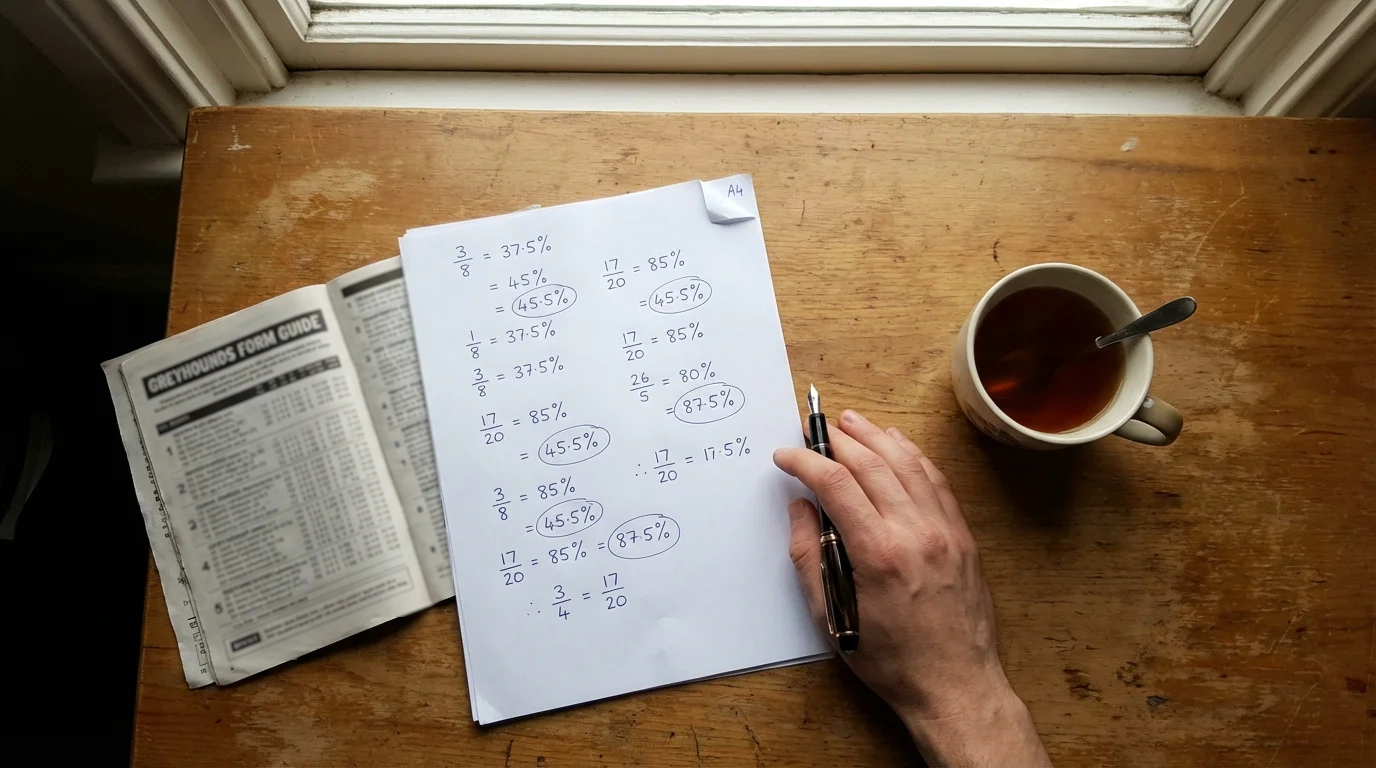
Every set of greyhound ante-post odds is a disguised probability statement. When a bookmaker prices a dog at 10/1 for the English Greyhound Derby, they’re not just offering a payout ratio — they’re implying that dog has roughly a 9% chance of winning. Whether that implied probability reflects reality is another matter entirely, and the gap between what the odds suggest and what you believe to be true is where ante-post value lives or dies.
Most punters look at odds as payouts. A 10/1 shot pays ten times your stake. A 3/1 favourite triples it. That perspective isn’t wrong, but it’s incomplete. It treats odds as a reward structure without interrogating the underlying assessment of likelihood. And in ante-post greyhound markets, where prices are set by traders with limited information, thin liquidity, and wide margins, the implied probabilities embedded in those prices are often significantly disconnected from any reasonable estimate of the true chances.
This article is about learning to see odds as probabilities first and payouts second. The mechanics are straightforward — the maths involved is basic division, nothing more. But applying those mechanics to real ante-post greyhound markets requires understanding what the numbers mean in context: what the overround is, why greyhound futures markets carry higher margins than most other sports betting products, and how to use implied probability as a practical filter for separating decent bets from bad ones.
If you’ve been betting ante-post on greyhounds by gut feel and price comparison alone, this won’t invalidate that approach. But it will give you a quantitative layer to sit alongside your instincts — a way to check whether the odds you’re considering actually represent the kind of probability you’re comfortable betting against.
How to Convert Greyhound Odds to Probability
The conversion from fractional odds to implied probability is one formula, and it works the same whether you’re looking at a 2/1 favourite or a 66/1 outsider. For fractional odds expressed as A/B, the implied probability is: B divided by (A + B), then multiplied by 100 to get a percentage.
Take a dog priced at 5/1 in an ante-post Derby market. The calculation is 1 divided by (5 + 1), which gives you 0.1667, or 16.67%. The bookmaker’s price implies this dog has roughly a one-in-six chance of winning the competition. At 10/1, the implied probability drops to 9.09%. At 25/1, it’s 3.85%. At 2/1, the market favourite, the implied probability is 33.33% — the bookmaker is suggesting this dog wins one time in three.
If you’re working with decimal odds — common on exchanges and some European-facing platforms — the conversion is even simpler. Implied probability equals 1 divided by the decimal odds, multiplied by 100. So decimal odds of 6.00 (equivalent to 5/1) give you 1/6 = 16.67%. Decimal odds of 3.00 (equivalent to 2/1) give you 33.33%.
The maths is trivial. The interpretation is where it gets interesting. When you convert an entire ante-post greyhound market into implied probabilities, you should find that the percentages add up to more than 100%. This is by design. If there are eight dogs quoted in an ante-post market and their implied probabilities sum to, say, 135%, that extra 35 percentage points represent the bookmaker’s margin — the overround. More on that shortly.
For now, the key habit to build is converting every price you’re considering into its implied probability before you decide whether to bet. This reframes the decision. Instead of asking “is 10/1 a good price?”, you ask “does this dog have a better than 9% chance of winning?” The first question invites emotional reasoning. The second demands an assessment grounded in evidence — what you know about the dog’s form, the trainer, the competition field, the track, and the stage of the tournament.
In practice, you don’t need to do this arithmetic in your head every time. A quick reference table covers the most common ranges. At 1/1 (evens), implied probability is 50%. At 4/1, it’s 20%. At 10/1, roughly 9%. At 20/1, roughly 4.8%. At 33/1, about 2.9%. At 50/1, roughly 1.96%. These benchmarks are enough to work with in most ante-post situations — you can estimate where a given price falls and then refine if the decision is close.
One important note: implied probability is not the same as true probability. The implied figure includes the bookmaker’s margin. A dog priced at 5/1 doesn’t genuinely have a 16.67% chance of winning according to the bookmaker’s private assessment — that percentage is inflated by the overround. The true probability the bookmaker assigns is lower, and the difference is their profit margin. To estimate the “fair” probability, you need to strip out the overround, which requires knowing the total market percentage first.
Understanding the Overround
The overround is the bookmaker’s built-in advantage. It’s the amount by which the sum of all implied probabilities in a market exceeds 100%. Every betting market has one — it’s how bookmakers guarantee a theoretical profit regardless of the outcome. In ante-post greyhound markets, the overround tends to be considerably higher than in most other sports.
Here’s a simplified example. Suppose a bookmaker prices four dogs for a competition final: Dog A at 2/1, Dog B at 3/1, Dog C at 5/1, and Dog D at 8/1. Converting each to implied probability: Dog A = 33.33%, Dog B = 25%, Dog C = 16.67%, Dog D = 11.11%. The sum is 86.11%. In a real four-runner market, you’d expect the total to exceed 100%, so let’s say there are two more runners priced at 10/1 (9.09% each). The total is now 104.29%. That 4.29% above 100% is the overround — the bookmaker’s margin on this market.
A 4% overround is tight. You’d see that on a competitive horse racing market or a well-traded football match. Greyhound ante-post markets rarely operate at that level. Because these markets are thin — few bettors, low volumes, limited information — bookmakers build in wider margins to protect themselves against the uncertainty. An overround of 120% to 140% on a greyhound ante-post market with 15 to 20 quoted runners is not unusual. On smaller events with limited fields, it can exceed 150%.
What does a 130% market mean for you in practical terms? It means the bookmaker has priced the field as though there are 1.3 races worth of probability distributed across one race. Put differently, every single price in that market is shorter than the “fair” price — every implied probability is higher than the bookmaker’s actual assessment of the dog’s chances. The markup is spread across all selections, though not always evenly. Favourites tend to carry a smaller markup relative to their price, while longshots bear a disproportionate share of the overround. This is a consistent pattern across all sports betting, but it’s especially pronounced in greyhound ante-post because the longshot end of the market is where bookmakers face the most uncertainty.
Calculating the overround for a specific market is straightforward. Convert every quoted price to its implied probability, sum them, and subtract 100. The result is your overround percentage. You can do this manually for markets with a handful of runners, or use a spreadsheet for larger fields. Some odds comparison sites display the total market percentage, which saves the arithmetic.
Why does the overround matter for your betting? Because it tells you how much value you need to find just to break even. In a 130% market, the average bet is overpriced by roughly 23% relative to fair odds (the margin distributed per selection). That means your assessments need to be meaningfully better than the bookmaker’s to turn a profit over time. You’re not starting from neutral — you’re starting from a deficit, and the size of the overround tells you how deep that deficit is.
This isn’t a reason to avoid ante-post greyhound betting. It’s a reason to be selective. In a high-overround market, you need to find individual selections where the mispricing exceeds the margin — dogs whose true probability of winning is significantly higher than what the odds imply. The overround just quantifies the hurdle you’re trying to clear.
Using Probability to Judge Ante-Post Value
Knowing how to convert odds and calculate overrounds is mechanical. The real skill is applying those numbers to actual ante-post decisions. The process is deceptively simple: estimate the true probability that a dog wins the competition, convert the available odds to implied probability, and compare the two. If your estimate of the true chance is higher than what the odds imply, you’ve found potential value. If it’s lower, the bet is overpriced for you, regardless of how attractive the payout looks.
The difficulty is in that first step — estimating true probability. Nobody knows the actual probability that a given greyhound will win a tournament-format competition several weeks from now. There are too many variables: form fluctuations, injuries, trap draws, weather conditions on race day, the quality of opposition in each round. What you can do is build a rough estimate based on what you know: the dog’s recent graded performances, the trainer’s track record in the specific competition, the entry strength, and the dog’s suitability to the track and distance.
Your estimate doesn’t need to be precise to a decimal point. It needs to be directionally correct and honest. If a dog is priced at 12/1, the implied probability is roughly 7.7%. Your assessment might be that the dog has about a 12% chance based on form and trainer history. That’s a meaningful gap — enough to suggest value even after accounting for a generous overround. Alternatively, you might look at a 4/1 favourite with an implied probability of 20% and conclude that the dog’s realistic chance is closer to 15%, which would make the price too short.
One useful technique is to work backwards from the price. Instead of trying to assign a probability from scratch, look at the implied probability and ask: is this dog’s chance of winning genuinely this low (or this high)? This forces you to engage with the specific number rather than defaulting to vague impressions. A dog at 25/1 implies a 3.85% chance. That’s approximately one win in 26 attempts. Does that feel right given what you know? If the dog is a graded racer from a strong kennel with a legitimate route to the final, one in 26 might understate its chances. If the dog is an untested novice from an unfamiliar trainer, one in 26 might even be generous.
The broader principle is that implied probability gives you a common language for comparing your view against the market’s. Without it, you’re comparing apples to gut feelings. With it, you’re comparing two estimates of the same thing — and the gap between them tells you whether there’s an edge worth backing.
Numbers Don’t Lie — But They Can Mislead
There’s a temptation, once you start thinking in probabilities, to treat the numbers as certainties. They’re not. Implied probability is a model, and like all models, it’s only as useful as the assumptions behind it. A dog you’ve assessed at 15% to win might genuinely have that chance — or your assessment might be wrong because you’ve underweighted an injury concern, overvalued recent form against weak opposition, or misjudged the competition field.
The overround calculation tells you the bookmaker’s margin, but it doesn’t tell you where that margin is concentrated. Two markets with identical overrounds can have very different value profiles — one might be efficiently priced across the board, while another has clear mispricings at specific price points. The aggregate number is a starting point, not a verdict.
And the biggest trap of all: false precision. Calculating that a dog has a 12.3% chance of winning based on a few data points feels rigorous, but the number itself carries more confidence than the analysis behind it warrants. Greyhound ante-post markets are inherently uncertain — that’s why the odds are big and the margins are wide. Pretending otherwise is just numeracy dressed as insight.
The value of implied probability isn’t that it gives you the answer. It’s that it gives you the right question. Instead of chasing prices that feel big, you start asking whether prices are big enough. That shift — from excitement about payouts to assessment of probability — is the difference between punting and betting. The numbers won’t make you right. They’ll make you think more clearly about when you might be wrong. In ante-post greyhound markets, that clarity is worth more than any single wager.