
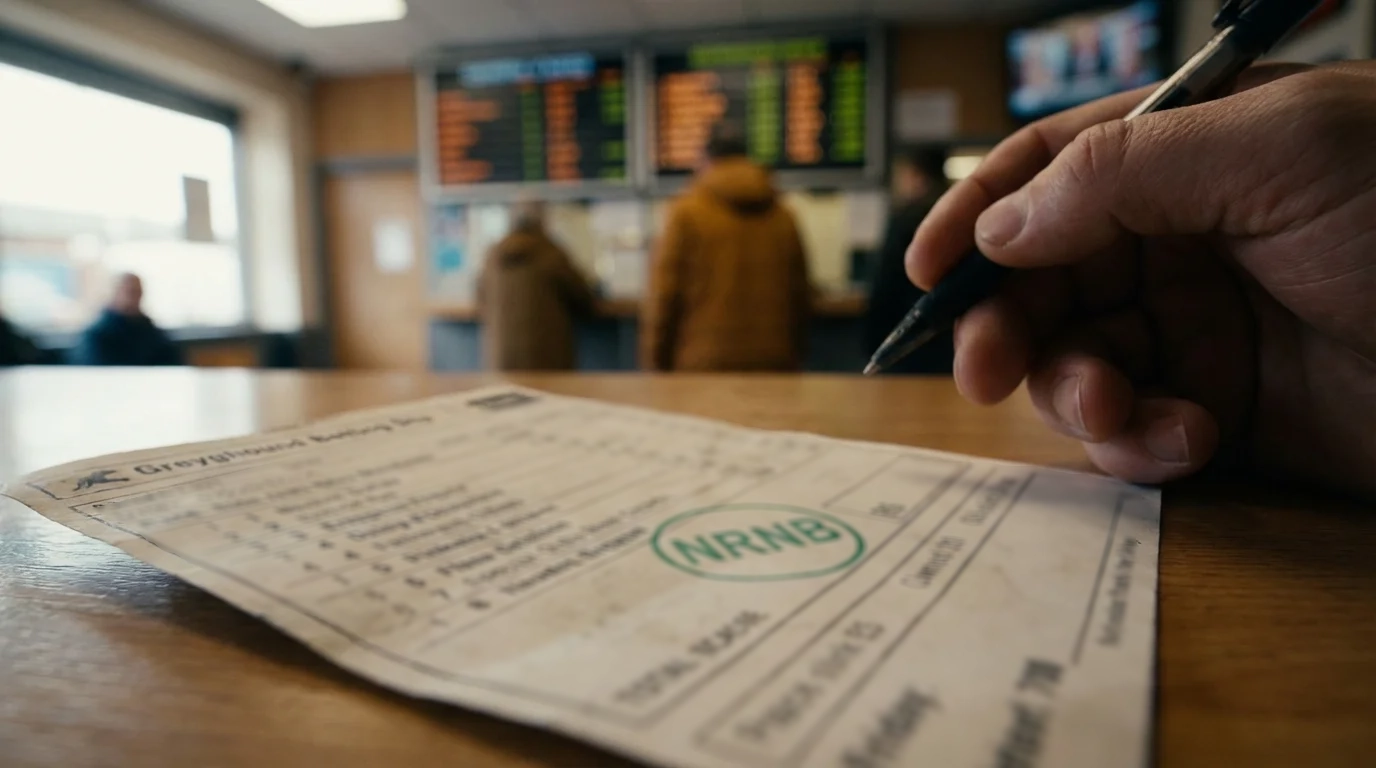
The standard rule in ante-post greyhound betting is blunt: if your dog doesn’t run, you lose your stake. No refund, no void, no second chance. That rule has been the default for decades, and it exists because bookmakers price ante-post odds on the assumption that some selections will never compete. The bigger prices you get in futures markets aren’t generosity — they’re compensation for exactly this risk.
No runner, no bet — commonly abbreviated to NRNB — is the exception. It’s a promotional term offered by some bookmakers on some ante-post markets that overrides the default forfeiture rule. If NRNB applies and your greyhound is withdrawn from the competition before it runs, your stake is returned. The bet is treated as void rather than lost. For punters, it removes the single most painful outcome in futures betting: paying for a dog that never made it to the track.
But NRNB is not as simple as the name suggests. The conditions vary between bookmakers, between events, and sometimes between individual markets within the same event. Understanding what NRNB actually covers — and what it doesn’t — is essential for anyone placing ante-post greyhound bets. The difference between knowing the terms and assuming the terms can be worth the entire value of your stake.
How NRNB Works in Greyhound Futures
The mechanics of NRNB are straightforward in principle. You place an ante-post bet on a greyhound to win a major event — the English Derby, the Irish Derby, the St Leger. If that dog is withdrawn from the competition before it races, the bookmaker voids your bet and returns your stake. You’re back to where you started, minus the opportunity cost of having your money tied up in a bet that went nowhere.
The critical word is “withdrawn.” NRNB protects against a dog not participating in the event at all. It does not protect against a dog that enters the competition, runs in the heats, and loses. If your ante-post pick runs in the first round and finishes last, your bet is settled as a loser — NRNB doesn’t apply because the dog did run. The protection is specifically against non-participation: injury before the event, trainer withdrawal, failure to be entered, disqualification before the first heat.
This distinction matters enormously in greyhound racing’s knockout tournament format. The English Derby runs over several weeks. A dog might be entered in the competition, run in the first-round heats, survive to the second round, and then be withdrawn due to injury before its next race. Whether NRNB covers that scenario depends entirely on how the bookmaker defines “not running.” Some NRNB offers cover withdrawals at any stage of the tournament — if the dog doesn’t complete the competition, you get your stake back. Others only cover pre-tournament withdrawals — if the dog runs in at least one heat, the bet stands regardless of what happens afterward.
The second interpretation is more common, and it’s the one that catches punters off guard. Under a typical NRNB offer with pre-tournament scope, your stake is refunded if the dog never enters a heat. But once it runs — even once — the protection expires. Every subsequent withdrawal, injury, or elimination is on you. This effectively means NRNB protects you against the dog being a complete non-starter, but not against the tournament attrition that accounts for the majority of ante-post losses.
Some bookmakers have experimented with broader NRNB definitions for marquee events. These offers cover withdrawals at any stage, essentially guaranteeing that your stake is returned unless the dog reaches the final. These are rare, valuable, and worth seeking out — but they come with their own conditions, typically including restrictions on the odds at which the bet must be placed or caps on the stake that qualifies for NRNB protection.
When evaluating an NRNB offer, the first thing to check is the scope: pre-tournament only, or full competition? The second is the trigger: does the dog need to be officially withdrawn, or does failing to qualify (eliminated in heats) also count? These two questions determine the actual value of the NRNB protection, and the answers are almost always buried in the terms and conditions rather than displayed prominently on the betting slip.
Which Bookmakers Offer NRNB on Greyhound Ante-Post
NRNB availability on greyhound ante-post markets is not universal. It’s offered selectively — by specific bookmakers, on specific events, and often for limited periods. The landscape changes year to year, and a bookmaker that offered NRNB on the 2025 English Derby might not repeat the offer in 2026. Treating NRNB as guaranteed is a mistake; treating it as something to actively check before every ante-post bet is the correct approach.
Among the major UK-licensed bookmakers, BoyleSports has been one of the most consistent providers of NRNB on greyhound ante-post markets. As the title sponsor of the Irish Greyhound Derby, BoyleSports typically offers NRNB or enhanced terms on that event’s ante-post market, and it has extended similar offers to the English Derby in recent years. The terms tend to be clearly stated on the market page, and the scope has generally been pre-tournament: if the dog doesn’t enter the heats, your stake is returned.
Paddy Power has also offered NRNB on greyhound futures, particularly for the English and Irish Derbies. Paddy Power’s promotional activity around major greyhound events is typically aggressive, and NRNB is one of the tools it uses to attract ante-post volume. The specifics change from event to event, so checking the market page and the associated terms before placing a bet is essential.
Bet365’s position on NRNB for greyhound ante-post is less consistent. Bet365 is widely regarded as having the deepest greyhound betting coverage among UK bookmakers — daily race cards, live streaming, extensive race-day markets — but its ante-post offerings for greyhounds have historically been more straightforward, with standard forfeiture rules and less promotional enhancement. NRNB on Bet365 greyhound futures is possible but not something to assume.
William Hill, Coral, and Ladbrokes all offer greyhound ante-post markets, but their NRNB policies on these markets vary and are typically event-specific. When NRNB is offered, it’s usually flagged on the market page with a promotional badge or note. If you don’t see it, it almost certainly doesn’t apply.
Oddschecker’s greyhound ante-post section is useful for identifying which bookmakers are currently offering NRNB on a given event. When comparing odds across firms, the NRNB status of each bookmaker’s market should be factored into your assessment. A dog at 20/1 with NRNB is a fundamentally different proposition from the same dog at 22/1 without it. The slightly shorter price with NRNB protection may represent better value once you account for the non-runner risk that the unprotected bet carries.
One practical point: NRNB offers are almost always tied to new bets placed during a specific promotional window. If you placed an ante-post bet before the NRNB promotion was announced, your existing bet typically won’t qualify. Bookmakers are explicit about this — NRNB terms apply to bets placed during the promotional period, not retroactively. If NRNB matters to your strategy, wait for the offer before placing the bet.
NRNB Limitations and Conditions
NRNB is not blanket insurance. Every offer comes with conditions that define its actual scope, and those conditions vary enough between bookmakers that generalising is risky. Here are the most common limitations.
Stake limits are standard. Most NRNB offers cap the stake that qualifies for the refund. If the maximum qualifying stake is £25 and you place a £50 ante-post bet, only £25 will be returned if the dog doesn’t run. The remaining £25 is subject to standard ante-post forfeiture rules. Always check the maximum stake — it’s usually stated in the terms and rarely displayed on the betslip itself.
Odds restrictions sometimes apply. A bookmaker might offer NRNB only on selections at odds of 10/1 or longer, excluding short-priced favourites from the protection. The logic is commercial — non-runner risk is most damaging on longshots where the stake represents the primary exposure — but it also means that if you’re backing a well-fancied dog at a short ante-post price, NRNB may not be available.
Bet type restrictions are common. NRNB typically applies to win-only bets, not each-way. If you’ve placed an each-way ante-post bet and the dog doesn’t run, the win portion might be refunded under NRNB, but the place portion may be treated differently — or the entire bet might fall outside the NRNB scope. Check whether your bet type qualifies before confirming.
Timing windows are firm. NRNB offers run for defined periods — often from market opening until a specified date, or for the first week of ante-post availability. Bets placed outside this window don’t qualify, even if the market is still open and the same event is being offered. Bookmakers enforce this strictly.
Finally, the definition of “not running” deserves scrutiny. As discussed above, the distinction between pre-tournament withdrawal and mid-tournament elimination is the most important variable. Some NRNB offers also exclude dogs that are disqualified after competing — if a dog runs in a heat and is later disqualified for a rule violation, the NRNB protection may not apply because the dog technically did run.
Insurance You Didn’t Know You Needed
Most punters discover the value of NRNB the hard way — by losing a stake on a dog that pulled up lame three days before its first heat. That’s a particular kind of frustration, because it has nothing to do with form analysis, odds assessment, or any of the skills that are supposed to determine whether a bet succeeds. It’s pure structural risk, the one part of ante-post greyhound betting where the punter has zero analytical control.
NRNB doesn’t eliminate the volatility of ante-post betting. It doesn’t protect you from bad picks, poor timing, or dogs that enter the tournament and lose in the first round. What it does is remove the most arbitrary source of loss — the one where your money disappears because of an event that has nothing to do with the dog’s racing ability or your research.
For serious ante-post greyhound bettors, checking for NRNB availability should be as automatic as checking the odds. It takes thirty seconds to read the market terms, and those thirty seconds can save you an entire stake. The bookmakers know this, which is why they offer it selectively and with conditions. It’s a tool, not a gift — and the punters who use it consistently are the ones who lose less on the bets that never had a chance to win.