
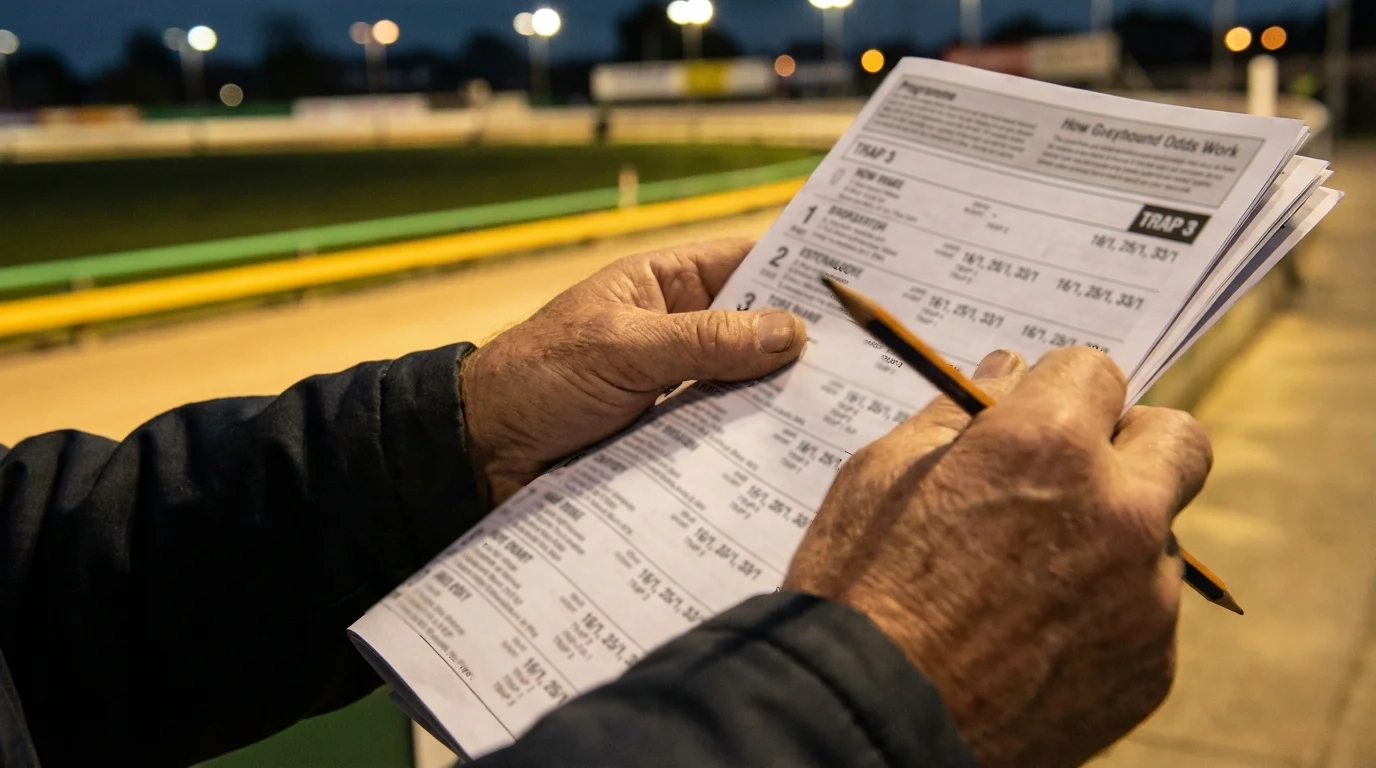
Ante-post greyhound odds aren’t predictions — they’re a bookmaker’s estimate of uncertainty, and you’re buying or selling that estimate. This is worth saying at the start because most punters approach odds as if they represent truth. They see 16/1 and think: “this dog has roughly a six percent chance of winning.” In reality, 16/1 represents what the bookmaker thinks they can charge you for that outcome given the information available to them, the money they’ve already taken, and the margin they need to protect. The distinction between probability and price is the foundation of everything that follows in this guide.
In greyhound ante-post markets, that distinction is sharper than in almost any other betting product. Horse racing ante-post benefits from deep public form databases, televised gallop reports, trainer interviews, and a betting public large enough to push prices toward something resembling efficiency. Greyhound ante-post markets have none of that infrastructure. The form data is sparser. The betting volume is a fraction of what horse racing attracts. The markets are thinner. And because they’re thinner, the prices are set by fewer hands — sometimes a single trader at a bookmaking firm making judgments based on a limited set of trial times and grading records.
This is not a complaint. It’s an opportunity. Thin markets are inefficient markets, and inefficient markets are where the bettor with better information — or even just more patience — can find prices that don’t reflect the true probability of an outcome. But to exploit that inefficiency, you need to understand how the pricing works. You need to know what drives a price from 33/1 to 16/1 overnight, what the overround on a typical greyhound ante-post market looks like, and how to convert a fractional price into an implied probability that you can compare against your own assessment. Without that toolkit, you’re just staring at numbers. With it, you’re reading a market — and occasionally catching it napping.
How Bookmakers Set Ante-Post Greyhound Prices
There’s no algorithm behind most greyhound ante-post markets — just a trader and a spreadsheet. That might sound glib, but it’s closer to the truth than the sophisticated modelling that punters sometimes imagine. Major horse racing futures markets are priced using a combination of historical data, current form models, and real-time market signals from exchanges. Greyhound ante-post markets are priced by a human being at a bookmaking firm who has access to a dog’s grading history, some trial times (if publicly available), general kennel reputation, and a feel for what the betting public will do with the prices. That’s it.
The process starts weeks before a major event. A trader reviews the expected entry list for a race like the English Greyhound Derby or the St Leger. They assign provisional odds based on a rough assessment of each dog’s chance of winning the final. The top-rated dogs — typically those with strong recent form in open races, from well-known kennels — are priced short: 8/1 to 14/1 range. Dogs with solid form but less public profile sit in the 16/1 to 33/1 bracket. Below that, it’s a broad spread of prices from 40/1 out to 100/1 or longer for dogs that are entered but have limited form at the required level.
What the trader doesn’t have is critical. They don’t know which dogs will be confirmed entries and which are speculative nominations. They don’t have access to private trial times that trainers run behind closed doors. They can’t predict which dogs will improve over the coming weeks and which will plateau or regress. They have no reliable way to model how trap draws across multiple knockout rounds will interact with a dog’s running style. The market they produce is the best available given those constraints — but the constraints are significant, and they leave wide gaps between the market price and the true probability.
Once the market is published, prices move based on a combination of money and information. If a well-known punter or syndicate takes a position on a dog, the bookmaker will shorten its odds even if no new public information explains the move. If a trial report leaks suggesting that a particular dog clocked an impressive time at the event track, prices adjust. But because these markets attract relatively low volume — nothing compared to horse racing ante-post — small amounts of money can produce large price swings. A single thousand-pound bet on a 40/1 shot can halve the price if the bookmaker’s liability limit for that market is modest. The bookmaker’s built-in margin (the overround, which we’ll break down later) ensures they’re still protected — but the prices individual punters see can shift dramatically on minimal activity.
The manual, low-data nature of greyhound ante-post pricing has one major upside for the informed bettor: the prices are stickier than they should be. A trader who has set a dog at 25/1 may not revisit that price until meaningful money comes in or a headline forces a reassessment. If you’ve identified that a 25/1 shot is genuinely closer to a 14/1 chance based on form and kennel analysis, that price can sit there for days while the market sleeps. In horse racing, such a discrepancy would be arbitraged away within hours. In greyhound ante-post, it can survive until race week.
Understanding Odds Movement in Greyhound Futures
When a 40/1 shot drops to 16/1 overnight, someone knows something. Maybe. Or maybe a punter with a large bankroll and a strong opinion simply decided to act. The challenge with interpreting odds movement in greyhound ante-post markets is that the signal-to-noise ratio is poor. In horse racing, a sudden shortening of odds is usually traceable to a credible information source — a well-connected stable, a betting syndicate with a track record, a journalist who has visited the gallops. In greyhound racing, the information chain is shorter and less visible. A trainer runs a private trial; the result reaches a handful of people; one of them backs the dog; the price moves. By the time the broader market notices, the value has already been claimed.
Still, odds movement is the single most useful real-time signal available to ante-post greyhound bettors, and learning to read it properly can sharpen your timing significantly. The key is to distinguish between three categories of movement: information-driven moves, volume-driven moves, and market-correction moves.
Information-driven moves are the most important. These happen when a genuine update about a dog’s form, fitness, or entry status reaches the market. A strong trial time at the event track, a trainer confirming a dog as their stable star for the competition, an injury report about a rival — any of these can shift a dog’s price and do so for legitimate reasons. These moves tend to be sustained: the price shortens and stays short (or continues to shorten) because the underlying probability has genuinely changed.
Volume-driven moves are noisier. A punter places a large bet, the bookmaker reduces the price to manage liability, and the price appears to “move” even though nothing has changed about the dog’s chances. In a thin greyhound ante-post market, a bet as small as a few hundred pounds can trigger a visible price shift. These moves are often temporary — the price drifts back once the bookmaker has balanced their book — but they can fool observers into thinking there’s market intelligence behind the movement. The best way to detect a volume-driven move is to check whether the same price movement is happening across multiple bookmakers simultaneously. If one firm’s price has shortened but others haven’t budged, it’s likely a single-bet effect, not a market-wide signal.
Market-correction moves happen when the bookmaker adjusts prices to realign the overround or to reflect new information that was already semi-public but hadn’t been priced in. These are mechanical, not informational. They often happen in batches — multiple dogs’ prices shift at once — and they rarely tell you anything useful about individual selections.
Steaming and Drifting in Ante-Post Greyhound Markets
The terminology is borrowed from horse racing but applies directly. A dog that is “steaming” is one whose odds are shortening rapidly across the market. A dog that is “drifting” is one whose odds are lengthening. In day-of-race betting, these movements happen over minutes. In ante-post, they play out over days or even weeks, which gives you more time to observe and react but also more room for misinterpretation.
Steaming in greyhound ante-post usually means one of two things: a well-connected bettor has taken a position based on private information, or a series of small bets from the public has pushed the price down cumulatively. The first scenario is worth following; the second is not. How do you tell the difference? Speed and spread. An information-driven steam tends to happen quickly — the price drops at one bookmaker, then others follow within hours — and the movement is proportional across the market. A public-driven steam tends to be slower and more uneven, with the most popular bookmakers seeing the biggest moves while smaller firms lag behind.
Drifting is the inverse and is often more informative. When a dog’s price lengthens, it usually means that money has not materialised on that selection despite the bookmaker expecting it to. In ante-post greyhound terms, a drifter is a dog that the market has reassessed downward — either because new information has emerged (a poor trial, a fitness concern, an unfavourable early draw) or simply because the initial price was too short and the market is correcting. A dog drifting from 12/1 to 20/1 in the two weeks before heats is not necessarily a dog to avoid — it may be drifting because sharper money has moved elsewhere, leaving the dog underbet but not necessarily overpriced. This is where your own form analysis earns its keep: if the drift is driven by weak information and your fundamentals haven’t changed, the lengthening price might actually represent improving value.
Implied Probability and Overround in Greyhound Ante-Post
Convert odds to percentages before you decide anything. This is not optional advice — it’s the single most important analytical habit in ante-post betting. Fractional odds are familiar and easy to understand as payouts, but they’re misleading as a tool for assessing probability. When you see 25/1, your brain registers “long shot.” When you convert that to 3.8 percent implied probability, your brain can actually work with the number: is this dog’s true chance of winning higher or lower than 3.8 percent?
The conversion formula is straightforward. For fractional odds expressed as A/B, the implied probability is B divided by (A + B), multiplied by 100 to get a percentage. So 25/1 becomes 1 / (25 + 1) = 0.0385, or 3.85 percent. For decimal odds, it’s even simpler: 1 divided by the decimal price. Decimal 26.0 gives you 3.85 percent — the same thing. The important step is doing this for every selection you’re seriously considering, then comparing the implied probabilities against your own estimates.
Here’s where the overround comes in. If you convert every dog’s odds in an ante-post market to implied probability and add them all up, the total will not be 100 percent. It will be higher — typically between 130 and 160 percent for a greyhound ante-post market with a large field. That excess is the bookmaker’s overround, and it represents their built-in profit margin. The higher the overround, the more the market’s prices collectively overstate the probabilities of all outcomes, and the harder it is for a bettor to find positive expected value.
To illustrate: if a Derby ante-post market has a total overround of 145 percent, that means the bookmaker is charging roughly 45 percent in excess margin spread across all selections. Some of that margin is loaded onto outsiders (their prices are slightly shorter than they should be), and some is distributed across mid-range prices. The favourites tend to carry the least margin, because they attract the most scrutiny and the most volume, which keeps their prices honest. It’s the 20/1 to 66/1 range — the middle and outer tier of the market — where the overround is most concentrated and where discerning bettors can sometimes find prices that are still generous despite the bookmaker’s margin.
You can calculate the overround for a specific market by summing the implied probabilities of all selections. This takes a few minutes with a spreadsheet or any odds-conversion tool. The number itself tells you how expensive the market is: an overround of 130 percent means you need to be, on aggregate, 30 percent better at assessing probability than the prices suggest in order to break even. An overround of 155 percent raises that bar considerably. Comparing overrounds across bookmakers for the same event is a useful shortcut — the firm with the lowest overround is offering the most bettor-friendly prices overall, even if they don’t have the single best price on every individual selection.
One thing to keep in mind: overround in greyhound ante-post is structurally higher than in horse racing equivalents because the fields are larger and the markets are less liquid. A horse racing Derby ante-post with 20 to 30 entries will have a tighter overround than a greyhound Derby ante-post with 100-plus entries. This isn’t a flaw in the greyhound market — it’s a feature of its size and structure. Accept the higher margin as a cost of playing in this particular arena, and focus your energy on finding the specific selections where the price is mispriced in your favour, rather than trying to beat the market on aggregate. You won’t. Nobody does consistently. But you can find individual bets where the bookmaker’s estimate of uncertainty is further from reality than your own.
Comparing Odds Across Bookmakers
Shopping odds in ante-post greyhound markets isn’t optional — it’s where half the value lives. In day-of-race greyhound betting, prices across major bookmakers tend to converge within a few minutes of market formation. The starting price is publicly anchored, and the competitive pressure of a live market keeps firms roughly aligned. Ante-post markets don’t have that anchor. Each bookmaker sets their own prices independently, and because the volume is low and the information is sparse, those prices can diverge wildly. Finding the same dog at 20/1 with one firm and 33/1 with another is not unusual — it’s the norm.
The primary tool for comparing greyhound ante-post odds in the UK is Oddschecker. It aggregates prices from major bookmakers into a single grid view, sorted by best available price. For a Derby or St Leger ante-post market, Oddschecker will typically show prices from six to ten firms, and the spread between the best and worst price on any given selection can be a factor of two or more. That’s an enormous gap. If you’re backing a dog at 20/1 when 33/1 is available elsewhere, you’ve given up sixty-five percent of your potential return for no reason other than not checking.
Betfair and other betting exchanges offer a different kind of price signal. Exchange prices reflect what actual bettors are willing to offer — not what a bookmaker’s trader has decided. In greyhound ante-post, exchange markets are often very thin (liquidity is a persistent issue), which means you can’t always get matched at the displayed price. But the exchange price serves as a useful reference point. If a dog is available at 25/1 with a bookmaker but the exchange back price is 18/1, the market is telling you that bettor consensus puts the dog’s chance higher than the bookmaker’s price implies. Conversely, if the bookmaker has a dog at 14/1 and the exchange back price is 20/1, the bookmaker may be pricing the dog shorter than the market supports — potentially because early public money has pushed the price down.
Beyond headline odds, there are three factors that should influence which bookmaker you actually place the bet with. First, non-runner terms. If one firm offers “no runner no bet” on the Derby and another doesn’t, the NRNB firm may offer slightly shorter odds — but the protection against withdrawal is worth the price difference on any dog that carries meaningful non-runner risk. Second, each-way terms. In ante-post markets where each-way is available, the place terms (quarter odds for two places, fifth odds for three places, etc.) vary between firms and can make a material difference to the expected return of an each-way bet. Third, cash-out availability. Some bookmakers allow you to cash out ante-post greyhound bets during the tournament; others do not. If you think there’s a scenario where you’d want to take profit mid-tournament — say, your dog reaches the semi-finals at a much shorter price than you backed it — the ability to cash out has real economic value.
A practical workflow: before placing any ante-post greyhound bet, check Oddschecker for the best available bookmaker price, check Betfair for the exchange back price, and note the non-runner terms and each-way conditions at the best-price firm. This takes five minutes. It will save you money over the course of a season, and in a market where margins are tight and non-runners eat into your bankroll regularly, those savings compound. The single biggest improvement most ante-post greyhound bettors can make is not a better form model or a sharper eye for trial times. It’s checking more than one price before clicking “Place Bet.”
The Margin Is the Message
The bookmaker always knows less than you think — and more than you’d like. That tension is the entire story of ante-post greyhound odds. The trader setting the market doesn’t have a crystal ball or a secret data pipeline. They have the same form records you can access, a feel for market sentiment, and the commercial imperative to set prices that attract money while protecting the firm’s liability. Their advantage is not information. It’s the overround — the structural margin baked into every price that ensures the house comes out ahead in the long run, even when individual bets go against them.
Your advantage, if you have one, is specificity. The bookmaker is pricing a market of 50 to 200 outcomes simultaneously. You are focusing on one or two selections that you’ve researched in detail. That asymmetry of attention is real. A trader who spends five minutes pricing each of 120 Derby entries cannot give the same scrutiny to every dog that a punter gives to the three or four they’ve shortlisted. If your research is better than the five minutes the trader allocated to your selection, the price may be in your favour. Not dramatically — this isn’t a broken market — but enough to matter over repeated bets across a season.
Embrace the inefficiency of thin ante-post greyhound markets. That’s where the opportunity is — and also where the danger hides. The same thinness that lets a skilled bettor find a mispriced 25/1 shot also means the market won’t correct your mistakes. There’s no crowd to anchor you, no efficient-market hypothesis to fall back on. You’re on your own, reading a sparse set of numbers that a single trader put together on a Tuesday morning. If you’ve done the work, those numbers are an invitation. If you haven’t, they’re a trap. The margin is always there, either working for you or against you. Knowing which side you’re on — that’s the real skill in ante-post greyhound betting.